Is it easy to migrate to Drupal 9?

Is this the end of the shock rebuild? Kanopi’s take on the Drupal 9 promise.

Drupal 9 has arrived! 

Powering one in every 30 websites across the globe, Drupal launched its latest, most innovative version earlier this month. Drupal 9 is flexible, inclusive, easy to use and faster than ever before. 

Here at Kanopi, we’re thrilled by how many people have already contacted us about upgrading to D9. The good news is, unlike previous migrations from D5, to D6 and D7, moving to D9 couldn’t be easier. If you are considering a move to Drupal 9, we’ve summed up just how easy it is to do, and the benefits of moving to D9 now. 

‘The easiest upgrade in a decade’

Drupal has claimed the move to D9 is their easiest major upgrade in more than 10 years. Now that we’ve had the chance to perform core upgrades for a number of client sites, we can say with confidence the move from D8 to D9 really is as easy as they say it is. Lead Developer of Drupal, Dries Buytaert explains the ease of the move to D9,

 ‘The big deal about Drupal 9 is that…it should not be a big deal.’ 

Dries Buytaert

If you’re operating on Drupal 8 and are ready to move to Drupal 9, look forward to:

  • The end of the shock rebuild: the need to start building your site from scratch is a thing of the past (Yes, really!) 
  • Cutting edge technology: the platform will be supported with security fixes from November 2021 and will have the ability to add new features twice a year.
  • Tools that are easy to use: Drupal’s technical architecture made even easier to use with a new layout builder, content workflow tools, and a WYSIWYG media management system.

The move to D9 is so painless, our own Director of Marketing & Communications, Allison Manley had to cry out a Hallelujah! 

Drupal 9’s forward-looking technology means Kanopi developers are better equipped to build the most intuitive online experiences and sustainable web platforms. Using the very best frameworks available, including emerging channels such as VR applications and digital assistants, we can help you meet your user’s needs now and in the future.

One thing to note: Drupal 9 core is easy to upgrade, but the contributed modules and custom modules may take a bit of time, depending on the state of the community contribution or your code. That is why we recommend working with us to create a Drupal Transition Plan so we can skillfully make the move when the time is right.  

Ready to migrate your site to Drupal 9?

We’re not going to deny the uncertain times we currently face and we know a lot of people are operating on lean budgets to try and weather the storm. It might not be the right time for you to migrate your site, and that’s ok. Take a look at our Drupal 9 Planning Guide. We outline options whether you’re operating with D8, D7, or even D6. Kanopi can help you decide how best to extend the life of your website, with whatever version of Drupal you’re using.

But if you’re excited by the idea of upgrading to Drupal 9, or have questions about how D9 will affect your site, Kanopi is here to help. 

Contact us for Your Drupal 9 transition plan

Pantheon + Kanopi: Faster, Smarter, Safer WordPress for Enterprise

“WordPress is just a blogging platform.” Not anymore. It can be anything you need it to be when it comes to working with content and media.

At Kanopi, we love working with our partners. They provide amazing services that complement our own, giving our clients a full suite of needs so that their websites are as powerful and impactful as possible. 

One of our longest partnerships is with Pantheon, a WebOps Platform for open-source Drupal and WordPress websites. Their philosophy aligns with our own: that it’s more efficient and effective to make continuous improvements on a website rather than doing more expensive and disruptive monolithic rebuilds. Taking iterative steps towards improving your presence online is all about taking small bites to create big wins. 

As a testament to our partnership, Kanopi was thrilled to be included as one of four expert agencies in Pantheon’s new ebook: Faster, Smarter, Safer WordPress for Enterprise. This ebook shares valuable insights on how enterprise-level clients can best leverage WordPress for their needs, as well as how best to work with an agency partner. It also offers “myth-busting” sections to address misconceptions about the capability, security, and scalability of WordPress.

Since WordPress powers about 39.7% of all websites on the internet, it’s clearly a wonderful and proven platform for projects of all sizes. It may have originally started as a platform for bloggers, but it is increasingly popular for enterprise clients. Download the new ebook today to learn more. 

Download the Free ebook


Migrating from Drupal 7 to WordPress

Faye
Faye Polson

Spock: Compute to the last digit, the value of Pi. Computer: *screams*

This was the first thing that comes to mind whenever I’m asked “how do we migrate from Drupal 7 to WordPress”. It seems like an impossible task, like trying to calculate pi to the last digit.

Apples, Oranges, and Pi, oh my

Where Drupal has modules, WordPress has plugins. Where Drupal has nodes, WordPress has posts and pages. Drupal uses blocks, WordPress uses widgets.

Functionally these pieces all accomplish the same tasks, but technically they’re built differently. It means there isn’t a one click solution that will take all your Drupal content and smash it into a WordPress CMS, like replacing the center of an orange with an apple. It just doesn’t work like that.

Ultimately it comes down to this: a Drupal 7 database and a WordPress database are just too different. Their tables have different structures and names and they just don’t understand each other. And with any amount of customization possible on both sides of the equation, computers, or one click plugin scripts, just can’t make the leap.

A Developer Can Migrate D7 to WordPress

That’s right, where a computer fails, a human can succeed. Because the best way to migrate your content from D7 to WordPress is to execute a script (an automated process) that has been designed by a person who has some basic familiarity with the content in question. A developer can compare the different sets of data, determine where it should go, and create a script that tells a computer where to put what. They can also set up the receiving database with tables and columns that match any customizations needed.

Piece by piece, developers can identify the needed tables from your Drupal 7 database and how to migrate them into a WordPress database. It’s not a fast process, but it’s a careful and deliberate one, meant to preserve essential content and data.

Content Migration, Check. What about style and function?

Even though we’ve got your core content, there’s no way to mash a Drupal 7 module or block in a WordPress plugin or widget. Those will need to be built again, using your existing site as a template for the outcome. A developer can absolutely make your site do the same things, but they will need to use a different set of tools. The good news is being able to see the existing function on your website will help them execute the same effect with clarity.

Themes and styles are a mixed bag. They don’t directly transfer, but often chunks of code can be reused, provided it’s clean, documented, and follows best practices. In some cases, it may be easier for a developer to start from scratch and merely mimic the existing theme instead of borrowing from it. Regardless, your site will still look the same at the end of the day whether it’s on Drupal 7 or WordPress.

This sounds complicated!

It is! It really is. But that’s the reason you hire an agency like Kanopi to do the hard stuff for you. Our team is experienced in both Drupal and WordPress, giving us a wide range of internal resources to rely on as we approach your project. We can also help you with choosing your hosting platform; not all hosts are created equal and some are CMS specific, like Acquia for Drupal or WP Engine for WordPress.

That said, there are things you can do in advance of your migration to make the process smoother and reduce the overall time and cost.

Curate Your Content

Go through your website, top to bottom. Are there pages that are no longer relevant? Are you keeping an archive of your blog posts back to 2001 even though your analytics show no user activity that far back? It’s time to hunker down and start cutting out the content you don’t need. Or at the very least, create an accurate list of what you do not need your developer to migrate. Cleaning up your content means there’s less to move, and what is needed is easier to consolidate.

Consolidate

Now that you’ve checked through your site, are there areas that are too similar? Do you have a support page and a content page but the only difference is the url and the title? It’s time to trim away duplicate and redundant content. Redirects can handle your url changes, and your users will appreciate a more streamlined approach to using your site.

Update Your Site / Modules

If your site is out of date, it’s a security risk, plain and simple. And out of date modules can perform in unexpected ways; you don’t want incorrect functionality being copied to your new site. Getting everything up to date and verified will ensure there’s no confusion about what’s expected.

Remove Unwanted Sections / Functions / Content

Does your site have unpublished nodes? Are you saving them for something important? If not, it’s time to purge. Clean out that unused content. Got functions you’re not really fond of? Remove that too. Styles you don’t like? DELETE. Get rid of anything you don’t want; there’s no point in paying to have it moved to WordPress. 

Clean Up Your Code

Sloppy themes and templates are bad for a lot of reasons, but specifically it’s not something you want to migrate to your new WordPress site. Cutting corners and using messy code will only cause problems later on. Getting your theme files documented at the very least will make a big difference when it’s time to rebuild them. Not to mention, Drupal and WordPress coding standards are going to differ, there’s some work that could be done ahead of time to ease the transition.

Compute to the last digit, the value of Pi

Unlike computing pi, going from D7 to WordPress is actually possible, even if it’s not easy. And that’s why Kanopi is the agency you want to partner with. We want to work with your site before it’s time to migrate. Our team will get to know your website (the good and the bad) through ongoing Drupal 7 support. We can help you with the content, the consolidation, the updates, and the code in advance of moving to WordPress. And when it’s time to start the nitty gritty migration, we’ll be ahead of the game with far much more than a basic understanding of your site; your needs and goals will already be a part of our roadmap.

Start Your Project With Kanopi

When to Move from Drupal to WordPress

Faye
Faye Polson

Drupal is an incredibly powerful Content Management System (CMS).

It’s a powerhouse tool, and incredibly robust. In fact, it can do pretty much anything you can imagine a website doing. 

And yet across the globe, out of all the websites built with a CMS, WordPress dominates with nearly 60% of the market share, while Drupal just squeaks over 4.5% and is barely knocked out of second place by Joomla!.

Why would anyone switch from Drupal to WordPress?

Because sometimes a power tool isn’t the right tool. Imagine buying a chainsaw to cut delicate flowers for an art project. I don’t doubt it would be amazing to watch, but it would ultimately be a messy, expensive endeavor with an outcome that doesn’t look anything like the result you would have gotten if you’d just used a regular pair of craft scissors.

Maybe you went with Drupal because you didn’t know there were other options. Or maybe Drupal seemed like the right CMS at the time, but now that you’ve had your site for a few years it isn’t quite what you’d been hoping for. Perhaps your needs and goals have significantly changed, and your site no longer lines up. 

Regardless of how you ended up with a Drupal site, you now wonder if you need a different tool for the job.

Drupal vs WordPress

Before you decide to move away from Drupal, it’s a good idea to take a look at what both Drupal and WordPress can do specifically for you. They’re both quality platforms that can get the job done, but they do excel in different ways.

5 Advantages of Drupal

  1. Robust User Access Control
    If you need a lot of users, or various permissions and access controls, then Drupal is going to give you more options from the start, with plenty of room to grow.
  2. Multilingual Functionality
    Drupal has multilingual functionality baked right into the core. If your audience is multilingual, or your site will be used by a variety of countries, you’ll want this out of the gate.
  3. Easier to Keep Secure
    Drupal core has a lot to offer developers, meaning they often don’t need as many third-party additions and extensions. Fewer modules means fewer potential holes in a site’s structure. If you’re storing sensitive data, you’ll want to consider this angle
  4. More Flexible Content Types, Views, and Taxonomies
    Of course other CMSs have these capabilities, but Drupal has increased flexibility and control over how your content is displayed and the relationships between data.
  5. Better for Storing Huge Amounts of Data
    Large directories, content types, products, etc., require big solutions. If you need to store hundreds of thousands of entries, you will want something made the handle that kind of bulk.

5 Advantages of WordPress

  1. Easier to Use
    Overall, WordPress is highly user friendly and non-developers have a much easier time using the administrative backend, and Gutenberg has made the content editing process even better.
  2. Larger Library of Extensions and Themes
    Because WordPress has such a high rate of use across the world wide web, it has a huge community, with a massive library of plugins and themes, both free and paid. There’s plenty to choose from and you’ll almost always find a ready-made solution.
  3. Easier to Get Developers and Support
    More usage means more developers, and more avenues for support. There’s no shortage of WordPress devs out there, nor a lack of communities and forums where you can find solutions for your site. 
  4. Lower Development Costs
    WordPress has more ‘out of the box’ solutions that require less customization and development time. Reducing costs in those areas means developers can focus their energies on other aspects of your site.
  5. Faster Builds
    Because of the ease of use, extendibility, community support, and available developers, WordPress builds tend to take less time. Your site can be up and running on a shorter timeline, and then continue to grow it as your budget allows.

How to Decide

Make a list of what you want your site to do for you. Add to that a list of things that would be nice to have, but aren’t absolutely necessary. Then make a list of barriers that you’re facing. Compare those items to the advantages listed above. At first glance, which CMS seems to address the majority of items on all three lists?

If it’s starting to look like you don’t need any of the high powered Drupal capabilities mentioned above, then maybe you’ve been using a chainsaw to cut paper flowers.

WordPress is an amazing pair of craft scissors

WordPress doesn’t own 60% of the world market share of CMS usage for no reason; it is a phenomenal platform. Developers can extend it to handle robust content needs, and can build most anything with or without third party tools. 

Security also doesn’t have to be a concern; using custom solutions reduces the security risks associated with excessive plugin use, and there are several security services and hosts that specialize in WordPress.

As your needs grow, WordPress can grow too. You don’t have to switch back to Drupal because three years down the line you suddenly find a need for tightly controlled user roles and permissions, those things can be built into your site. Same with multilingual solutions and large data storage. Over time your site might become a Swiss Army tool of sorts, with new attachments being added onto those craft scissors, but instead only adding what you need as you need it. Sometimes a precise tool is better than a power tool. 

Choose Your Tool

If a Drupal site is working for you, stick with it. We often recommend it for clients with complex needs, and who have a passionate crew of Drupal contributors. And as an agency that builds Drupal sites, we’re fans. But if it’s not working out, then maybe WordPress is the better tool for you. Whatever direction you choose, contact us if you need help. 

Chat with us about Drupal & WordPress

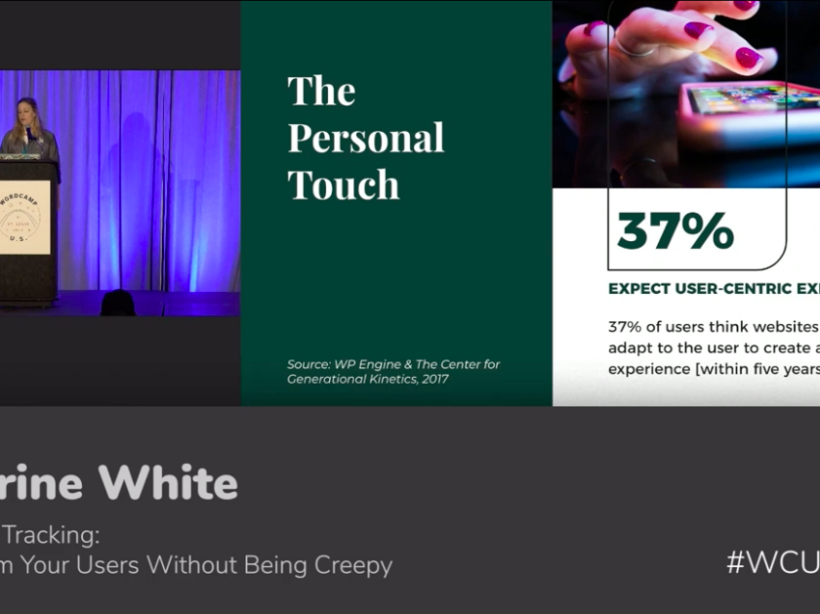
Split-screen of Kat White on left behind a podioum at WordCamp US, with an image from her slides on the right talking about user privacy.

Responsible Tracking: Learning from Your Users Without Being Creepy

Be transparent, responsible, and accessible.

In late October, I went with my colleague AmyJune Hineline to St Louis for WordCamp US, an amazing conference where the best and brightest in WordPress get together to learn and share knowledge. And I was thrilled to present this talk about Responsible Tracking. It’s one of my favorite talks since I believe it’s critical to find the balance between learning form your users without getting insidious with how the data is being collected. We all want to know more so we can make better websites that attract users, but we need to be responsible about it!

This talk exposes some touch points that you can leverage with WordPress (and other CMS as well) to help you learn about your users and how they interact with your site. I discuss tools that move beyond just your analytics platform to help you gain access to these insights, and walk through some core features of Google Analytics that you may not be aware of.

After this session, you’ll have a better understanding of the types of tracking tools, the information you can glean from them, and how to ensure your data tracking is responsible, transparent, and accessible.

A pile of silver forks, knives and spoons haphazardly dumped in a pile, demonstrating the messiness of a site not using custom post types..

Custom Post Types: Using WP for Content Management

Faye
Faye Polson

Confession: I don’t separate my cutlery.

I just grab a handful of forks and spoons and knives and shove them into the tray, ignoring the divisions made to help organize your utensils, and then just hope nobody ever looks in there to realize how ridiculously lazy I am.

Of course, separating my cutlery would make it easier to find what I’m looking for, especially considering I seem to have 6 million spoons and only 5 forks. It’s completely silly that I don’t.

WordPress has the same problem as my cutlery drawer

Out of the box, WordPress websites come with Posts and Pages. Pages are what we use to build a site’s homepage, contact page, about page, landing pages, etc. Pages almost always appear in the navigation menus of your site, otherwise users would have a hard time finding them.

Posts, on the other hand, are meant to show off content in an Archive. For example, a news feed, or a blog. They also auto publish; add a new post and it magically appears at the top of your blog page (which is actually not a Page). Posts also use Categories and Tags, which can be clicked on to view Archives of posts in those Categories or Tags.

Where this gets messy is when people use their Posts as sort of a catch all for content that doesn’t fit on a page. Press releases, resources, news, blogs, announcements, videos, links, etc. I’ve clicked on the “Posts” in the WordPress dashboard and cringed to see all that content jammed into one place, knowing it must be an absolute nightmare for the site owner to navigate and sort through.

Post Formats to the rescue?

Not exactly. WordPress has something called Post Formats which allows you to choose a format for your Post. You can choose if something is a video, or a link, or a gallery, a quote, etc.. But unless your theme has templates for each one of those types, they’re useless. And considering there are 9 post formats, that’s a pretty big budget consumer for something that still won’t solve the larger issue; there’s just too much cutlery in one place.

Custom Post Types to the rescue! For realz this time.

The truth is, WordPress is made up of posts. Users are posts, Categories and Tags are posts, files and images are considered posts, even Pages are posts! The entire infrastructure of WordPress revolves around this one method of data storage. As a result, it’s really easy to make more.

While there are Custom Post Types Plugins, a developer can literally add a custom post type through their own plugin, or to a theme’s functions, with just a few short lines of code. They can add Categories and Tags to it, tell it to behave like a Page or a Post, or give it it’s own custom taxonomies. This essentially means you can separate your content by purpose, and then present it back to the user accordingly.

Cleaning up the Cutlery Drawer: A Study in Books

Let’s get practical. I like cool used bookstores, so let’s imagine you have a used bookstore and need a website that works for the type of content you want to show.

The default Posts that come with WordPress, those will be your news / blog posts. Thanks to Gutenberg, you can really design your posts as you need them, without post formats and templates. 

You’ll want an Events section, so you can brag about the upcoming J.K. Rowing book signing, or the long awaited release of Book 3 from Patrick Rothfuss. With Advanced Custom Fields (ACF), Kanopi could make a robust Custom Post Type that has event dates and times, associated authors with their social media, promotional images. We could even display this in a calendar format with integrations for Google Calendar reminders.

Next, you’ll want a rare book section. Obviously your bookstore is amazing and has some serious stock that you’re not about to upkeep online, but there’s always those special books that could bring in the collectors. Our next Custom Post Type might be Rare Books, and with the magic of ACF, we could make bibliographies and a gallery of images of the book and some of its pages. Maybe a little history blurb about the book or what makes it such a hot ticket item for collectors.

Now, you’ll also want to draw in average readers and book lovers who maybe don’t have the budget for rare books, so let’s make a Custom Post Type for Recommended Reading where you can put together a list of some highlighted books that are likely to appeal to a wider audience. It can be categorized and sortable too, so users can browse and filter. It’s going to be amazing.

Lastly, a Team Custom Post Type, because your book store has a staff of six, plus the store cat (because you’re really cool like that). Each post becomes a Team Member page, with a bio, job title, and — this is where it gets really neat — you can associate them with their favorite books from the Recommended Reading posts. In fact, let’s go one further, we can attach your staff to the blog / news posts they’ve written and show that alongside their bios. Kanopi actually does this for our own staff.

Where previously you might just jam all this content onto a single page, or into a mash up of Posts, we can take all this content and give it custom data entry and custom templating that allows for some neat cross connection and interactivity for users to better travel your site and find what’s relevant to them. Have a cat that lives at the store? You never know . . . the store cat’s blog posts might be a huge hit.

Structured Content is Mappable Content

What if simply by telling your cutlery drawer what you’re having for breakfast, it was able to select the necessary eating implements for you? Having cereal? Here’s a spoon. Pie and ice cream? No judgement, here’s a serving knife, ice cream scoop, and a fork.

The additional advantage of an intentional content structure using custom post types is that you can then apply what’s called schema data to essentially map your content. Our fictional bookstore could actually pass specific information to Google about those rare books and events to get them in front of the people most likely to be genuinely interested. Consistent data is also extremely useful for filters and searches, announcement bars, feeds, and more. It allows for a deeper level of content strategy and design to better achieve your online goals.

Are you convinced to use Custom Post Types in WordPress? Ready to start stacking your silverware? 

Get organized with Kanopi
Kanopi Team

Metadata vs Schema

Faye
Faye Polson

It’s just data about data.

As a twenty something, I thought drawing a picture of Lt. Commander Data from Star Trek the Next Generation holding a clipboard of statistics about himself was a fantastic study aid for the definition of “metadata”. Okay, as a thirty something I still think that’s pretty funny.

Metadata essentially just that — data about data. It’s context for the information you’re about to consume. Nearly everything technical has it; when you take a picture on your smartphone, it stores the date and time the photo was taken, and some kind of generic name. If you have location services installed, it can even add where the picture was taken to its internal clipboard.

Most of the time metadata happens without us even realizing it, and nobody thinks twice about it until they want to improve their website Search Engine Optimization (SEO), which has definitely popularized the term. But for most people it’s just a huge ambiguous concept without any real concrete applications. 

So how does metadata work for your site?

Whenever you hop on your search engine of choice, for the purposes of this article we’ll be talking specifically about Google, your search results often come up with a website name, url, and a short description about the page. Every site has a title and url, and if it’s missing a description a good search engine will automatically pull the first few lines of text it can get from the site. 

Metadata Sample to demonstrate the difference between metadata vs schema

There’s a lot of misconception as to what this data is for, and how the search engines are using it, but the bottom line is that this information is for the user, not the search engine. This is your opportunity, as a website owner, to connect with your potential users. If you have the content they want to consume, this is where you tell them that. You have the ability to control your title, urls, and descriptions. Yoast is a fantastic extension for those kinds of edits, available for both WordPress and Drupal sites, but there are many others if Yoast doesn’t meet your specific needs.

Try it out

For fun, google your own company or organization, and see what comes up in the listings. Is it compelling? Does it accurately convey what you do and who you are? Would it appeal to a potential customer? If not, maybe it’s time to revisit your metadata content. Consider taking a look at your titles, urls, and descriptions for your most important pages.

If that seems like a daunting task, don’t fret; we can crawl your website and provide an audit of what search engines encounter when they navigate through it. Armed with that data, you can take an iterative approach to improving your pages based on importance.

Okay but then what is Schema Data?

Where metadata is data about data, schema is the map for that data. Take an events page, for example. It would have an event title, a ticket cost, a date, and a time. All that data is on the website, but how would a search engine know that unless you actually told it where to look and for what? Schema lets you assign context to that data. So along with the page that the user sees, you can send a map to the search engine that tells it the page is about an event, when it is, where it is, how much it costs, even the type of event. Is it a fundraiser, or a concert? Who’s organizing this event? Are there any promotional offers?

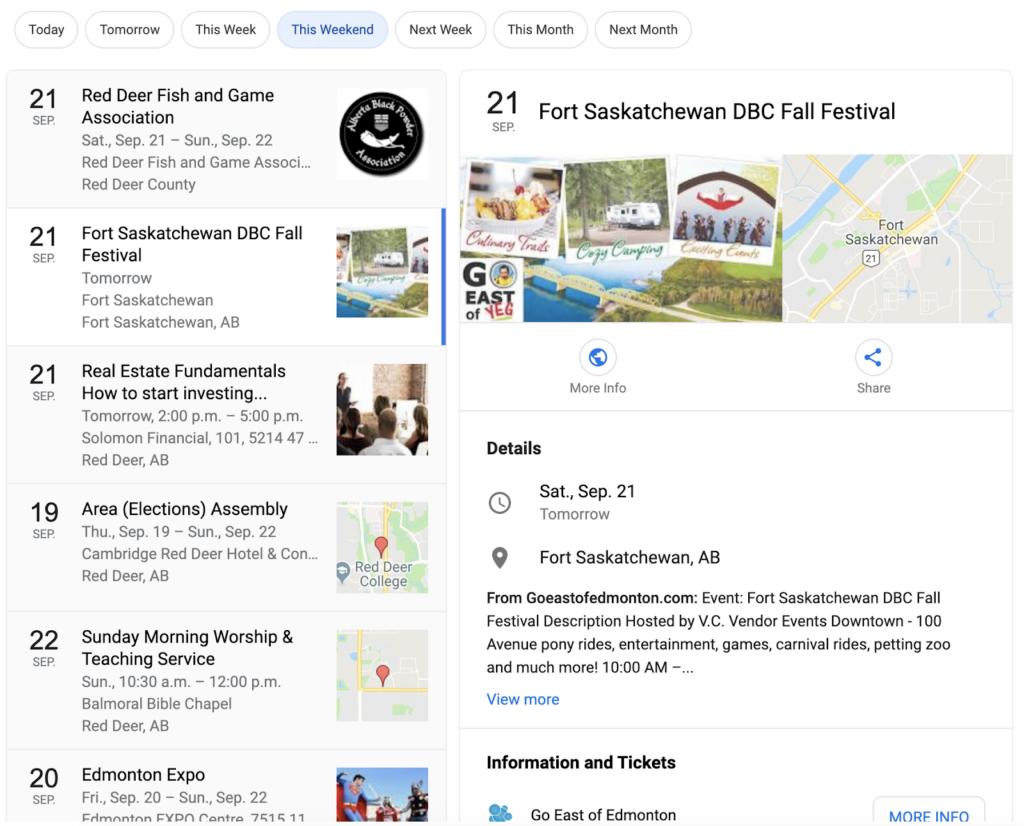
As an example, this is a Google search where I simply typed “upcoming events” and then chose “This Weekend.” Now I’m getting a list of events in the area with some relevant data.

Schema Sample that demonstrates metadata vs schema

How did it get there? Most likely those websites are utilizing schema data to map their event information. Google can find it now, understand its context, and present it in a relevant search.

How do I get schema data on my site?

Lucky for you, basic schema is possible with a plugin or module. Yoast, for example, adds some global site schema and basic page specific schema. Even just this alone can help boost your site’s content presentation to a search engine, and it’s a fairly low level of effort to integrate. If your site has an SEO plugin, you might already have some schema being applied. Head over to the Structured Data testing tool from Google and plug in your homepage to see what pops up. 

If you don’t see much, or you see a lot of errors, then you’re missing some valuable SEO leverage. But it usually takes a little more punch than third-party extensions can offer to get your specific content into schema markup; it’s time to hire a developer.

We’re not shy! Take a look at Kanopi’s schema markup.

Kanopi Homepage: Here we’ve been able to tell Google when our site was last modified, that we’re a company, all of our social media accounts, what our logo is, and what the most important image on the page is.

Staff Member Page: On Jim’s profile, we’ve got the global information included on the homepage, but we’ve also added that this specific page is about a person, with his name, his position, his picture, and all of his social accounts.

We’ve done the same for our blog pages, service pages, and case study pages. We’ve put extra care into communicating with search engines about the content of our site to better reach our audience, concentrating on the appropriate suggestions provided in the Google Search Gallery.

Schema can be applied to almost anything — in fact, the list of things you can use schema for will make your head spin. If you’re ready to move into the next stage of SEO, give us a call! The development experts at Kanopi are ready to help audit your site and develop a customized SEO plan to enhance your visibility among your target audience.

Team meeting

Accelerating Projects with Staff Augmentation

Jessica Skewes, Director of Strategy
Jessica Skewes

The are times the adage “less is more” applies to web projects. It can make a project a joy. Aligned stakeholder priorities. A single decision maker. Structural consistency. Design consistency. Simple, easy to understand requirements. Fewer, clearer calls to action to maximize conversions. Sounds great doesn’t it?

But sometimes you need staff augmentation when, “less is more” doesn’t work to our advantage. Places like timelines, budget and resources. When these are scarce, it creates a challenging environment for project success.

If this strikes home for you, you may be a team lead for web projects. You may be an expert in one or two disciplines in the project life cycle. And you may be way too familiar with the pain of projects that have gaps. You may need to extend or enhance the skills of your team to meet a deadline or budget.

The good news is, if resource constraints are your challenge, there are options!

Staff augmentation can help.

Expanding your team with outside experts is a time-tested way to accelerate your project life cycle or build the skills of your internal team. You can get fresh perspectives on the latest industry trends. You can avoid groupthink by bringing more diverse and varied experience and skill sets to a web development project.

At Kanopi, we understand the stress created by aggressive timelines, resource constraints, and knowledge gaps. “Nimble” is a core value, and offering seamless staff augmentation is one of the many ways we bring it to life: we have successfully partnered with clients and other agencies in a variety of ways to help them achieve their goals. We love the challenge of blending our skills with client teams to help your internal staff perform heroic feats for your end clients.

Jumping in to lend a helping hand 

Here are a few recent examples that demonstrate our team’s nimble agility in helping to save the day on a variety of projects across varied industries. 

The Berkeley School of Information 

The Kanopi team helped Berkeley’s School of Information by building out their new website on Drupal 8, all while training their internal team along the way. The Berkeley team is now well versed in Drupal 8 and needs only minimal support to maintain their highly-customized site. Berkeley’s Senior Director of Information Technology was thrilled with the results of our partnership, sharing that “The Kanopi team’s expertise and enthusiasm were critical to the success of our project. We couldn’t have done it without them.” 

Benetech Bookshare

Kanopi partnered with Benetech’s team to establish a rapid and repeatable process to translate the organization’s Bookshare websites into any language, making thousands of books accessible for people with visual impairment or other print disabilities around the globe. The Benetech team built the API, working with the Kanopi team to build out the websites. 

BC Services 

BC Services was racing toward the finish on a tight timeline to launch its Intranet. They needed help building out search and a complex custom homepage. In addition to jumping in to build out features, the Kanopi team was able to find ways to improve the site’s user experience while reducing technical complexity on the site. And the best part of all was that the project gained momentum and came in ahead of schedule with Kanopi’s extra help. Our main contact was so excited about this that he waited to tell his director that the project was ahead of schedule until the Kanopi team could be there to see the excitement on her face!

International Rescue Committee (IRC)

The Kanopi team is currently hard at work to help IRC meet website deadlines after their technical architect left the organization. Kanopi’s developers took the lead, writing user stories to ensure clarity, creating tickets, coaching and training development staff, and keeping all work on track. 

Need a hand? We can help.

Even with a fantastic internal team of seasoned experts, there are times when staff augmentation can assist with an extra hand or a niche skillset. Contact us if your latest project could use consulting services or helping hands within our full spectrum of web project services.

Kanopi’s Drupal development services focus on creating functional, sustainable Drupal websites.

How to Prevent Scope Creep

Managing the risks of scope creep will keep your website project running smoothly.

Your project is off to a good start; progress is being made, the timeline is being honored, and the budget is on track. Then one day you check your email and learn that a key stakeholder has left the project. You hear the suspenseful theme from Jaws in the back of your mind; this is the perfect scenario for that dreaded fiend scope creep to show up. 

I say fear not!  

Like a robocall in the middle of the night, scope creep is something nobody wants to encounter, especially during a project. That being said, it is also a natural part of any project and is bound to happen. The good news is that you can be proactive about heading it off at the pass, or preventing it from happening in the first place.     

Common Contributors to Scope Creep

Scope creep is the introduction of anything that can cause the focus or goals of a project to expand, and go beyond the original scope of the project. It’s not necessarily a bad thing when handled properly, but it can put the success of a project in jeopardy when handled poorly. 

Many factors can contribute to scope creep but most commonly it’s the humans that do the creeping. Any individual could knowingly or unknowingly contribute to creep; personal needs, internal politics, or the inability to make decisions are just some reasons that an individual or group can cause a project’s scope to expand. Other contributors to creep are:

  • A change in stakeholders
  • Revisions to the project goals
  • Introduction of new features or functionality
  • Additional rounds of revision to deliverables

With so many areas for creep to originate, how do you prevent it?

Preventing Scope Creep

The sad news is that you can’t prevent it from growing; humans are curious, and it’s natural that there will be questions and requests that will prod scope. So while you can make sure the team is educated in what the scope of the project is, there will always be some level of curiosity as to what additional is possible. 

You can, however, prevent it from affecting your project. I’ll go into greater detail as to specific approaches you can use for preventing creep, but it’s important to note that prevention starts with being engaged, and being a defender of the scope. 

It’s easy to be so caught up in the day to day running of a project that requests may be made or requirements added  that will push the boundaries. Consider yourself standing guard preventing those requests from making their way into the project. If you fall asleep at your post, you may find yourself clambering to remove the creep.     

Know What’s in Scope

Kind of a duh, I know, but this is so often overlooked. It’s not uncommon for project participants to come and go throughout the course of a project’s life cycle. Therefore every consideration should be given to making sure every person has reviewed the project scope; which should be provided in clear documentation that outlines the roadmap for the project. This may be in the form of a contract, proposal, or a project outline. If you don’t have one, define the scope before the project even begins.

The most effective documentation not only goes into detail as to what is IN scope, but also what is OUT of scope. This helps to clearly define where the focus will be for the project. Having participants review this documentation stops scope creep in the minds of those who might introduce it, and makes everyone a guardian of the scope.  

The project manager is the core individual monitoring the pulse of the project, and it is a big responsibility to act as the sole protector of scope. By imbuing this mission in others you build a team that can move together toward a single destination, rather than spending time keeping everyone on the same path. 

Establish an MLP

MLP stands for minimum loveable product; essentially the simplest version of your completed project that you can live with. An MLP can make a huge difference in ensuring that everyone on your project is rowing in the same direction. By clearly defining what makes up the MLP, you’ll have a goal in mind where the team can place their focus before working on lower priority, or scope creep items. This isn’t to say you can’t iterate and improve on the MLP once complete; by working on what’s most important you’ll at least have something that you’re happy with. Everything else is just icing on the cake.

Document the Changes

There will always be changes during the course of a project, it’s unavoidable and that’s fine. What’s important is how those changes are adapted to the existing scope. “Change Requests” turn new requirements or requests into official scope. They’re crucial especially when additional work is going to push the boundaries of a budget, and additional funding is needed. And if additional funding isn’t possible? A change request can clearly outline how existing scope items may change or be removed to make room. Without a change request, scope is not only going to creep but expectations are going to be misaligned.

Document the Risks  

We’ve talked about making everyone a guardian of scope, but because the team can’t be on alert 24/7, how do you focus everyone’s efforts so you know what to guard against?  Documenting risks is another way to reinforce the team’s focus. Risks are those items that you know could potentially impact the success of the project or cause the scope to balloon. You may already know what they are, or they could arise organically throughout the course of the project. Regardless, what is important is to document the risks and make sure the team has transparency into those items. Include a detailed description of the item, if known, a plan to address it, and better yet; assign someone to keep an eye on it.  

Scope creep also provides opportunities!

Hopefully I haven’t made scope creep out to be the villain; as much as it is something to be on the lookout for, it’s also an important opportunity to start planning for the future. Document, and track them; those items that may be scope creep now could also be the next positive expansion for your project.