





You’re hearing that AI changes what a website project costs and how long it takes, and you want to know what that means for yours. Some of the savings come straight back to you, mostly in migration. The rest goes into depth and speed that weren’t affordable before.
AI reduces the cost of content migration
Content migration can be one of the most time-consuming parts of a website rebuild. AI can significantly reduce the manual effort involved in inventorying, mapping, and preparing content for migration.
Picture packing up the old house and moving it into the new one, where every box gets sorted, labeled, and set in the right room. AI now handles much of that sorting and labeling, with people checking the results. The hours drop sharply, and so does the cost.
We can use AI to help identify redirect requirements and preserve metadata, reducing the risk of lost traffic and search visibility during migration. This is the biggest saving we pass along to you.
Every page gets audited
A content audit used to mean reviewing a sample and hoping it represented the rest. AI makes it practical to analyze content across an entire site rather than relying only on a representative sample. You see which pages earn their place and which should go, and you make those calls from the full picture of your site. Our content scorecard shows what gets checked on each page.
Accessibility issues get identified earlier
AI-assisted tools help identify accessibility issues and accelerate remediation. They can suggest alt text, generate draft captions, and flag common problems across a site. Accessibility specialists still review the results and test experiences that automated tools cannot reliably evaluate.
Projects can move faster
AI can shorten project timelines by accelerating content analysis, migration preparation, development, and testing. The actual savings depend on the project’s complexity, integrations, and how quickly decisions and approvals happen.
Your organization shows up in AI answers
Your buyers, donors, and members now ask AI tools like ChatGPT before they ever visit a website. Clear, well-structured, authoritative content can improve how AI-powered search tools discover, interpret, and represent your organization, although no optimization can guarantee inclusion in an AI-generated answer. Pages that put the answer first, use clear headings, and carry structured data are easier for AI to read and cite. That check can sit within your content audit so you see which pages are ready to be cited and which need work.
Our guide to improving brand visibility in AI search engines covers the full approach. Our explainer on how SEO, GEO, and AEO work together shows how it connects to the search work you already do.
Your editors write faster in your voice
AI can make your team quicker at drafting and updating content. The guardrails matter as much as the speed. We build voice and tone rules with you, so what your editors publish still sounds like your organization. A person still shapes the story, which is why we wrote about why you still need a copywriter in the age of AI.
Development goes further
AI-assisted CMS development speeds up the build process for your Drupal or WordPress site, so your team can review working pages sooner.
Agentic web development goes a step further. Agentic workflows can help teams turn plain-language requests into draft pages built from approved design components, reducing the time between a request and a reviewable preview. Agents work within a harness of approved information, reusable skills for your voice, design components, and a person who approves every change before it goes live.
With appropriate permissions, validation, and human approval, routine content updates can proceed more quickly without bypassing established publishing standards.
Design, research, and testing go further
AI also speeds up smaller tasks that add up across a project.
Prototypes arrive sooner
You react to something real earlier, and your team tests more ideas before the build starts.
Research covers more ground
AI can accelerate the analysis of analytics, interview transcripts, and survey responses, helping our strategists identify patterns and investigate findings more efficiently.
Automated testing covers more of your site
Automated testing can check more pages for broken links, visual regressions, and common functional issues. Our team investigates failures and validates the experiences that automation can’t fully assess.
Your team gets up to speed faster
Editor guides and training materials get built around your site, so new content goes live with less hand-holding.
Small requests move quickly
After launch, routine updates and fixes spend less time in a queue.
More time goes to strategy and design
By reducing repetitive work, AI gives our team more room to focus on the decisions that shape your results, from research and strategy to design and UX. Depending on the project, that efficiency can lower costs, shorten timelines, or allow us to invest more effort in the work that matters most.
Your team reviews everything AI touches
Your content stays yours. We use approved AI tools with appropriate data protections and do not authorize the use of client information for model training. Our AI workflows follow established security, privacy, and governance requirements. A person at Kanopi stays accountable for the quality, accuracy, and ethics of everything we deliver.
AI-assisted work follows the same review, quality assurance, and approval processes as other deliverables. Our team remains responsible for validating the work before release, and your organization retains its established approval authority.
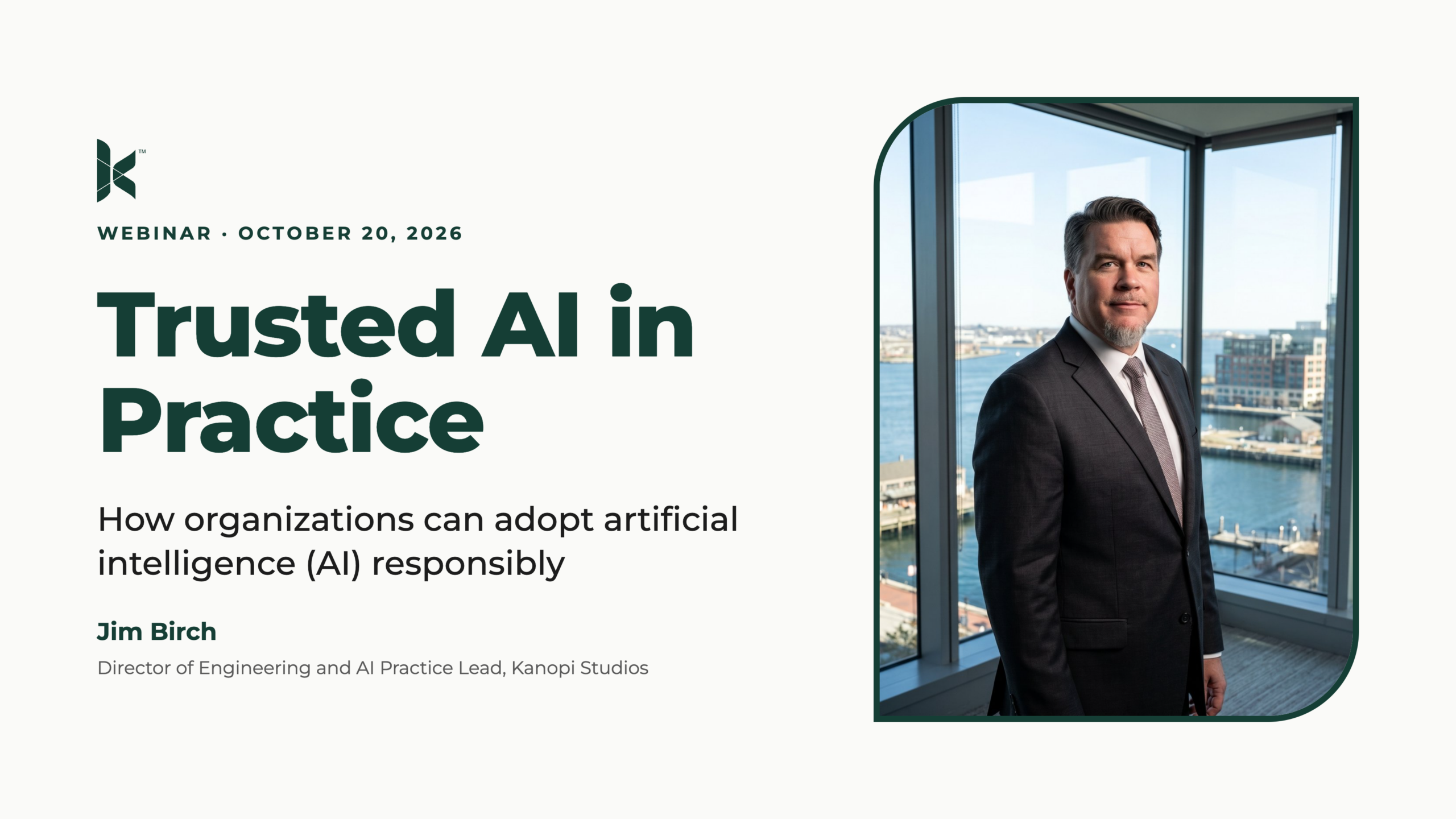
If your organization has its own AI policies, share them at the start, and we follow them. See how we approach this on our Trusted AI services page, or watch the webinar on adopting AI responsibly.
How you get the most from AI on your project
Decide quickly
Timelines shrink when approvals move. Pick a decision-maker early and keep feedback rounds short.
Line up your reviewers
Subject matter experts and approvers who know their dates in advance keep the work from waiting on a calendar.
Share your guidelines
Hand over your voice and tone guidelines, brand standards, and any AI policies. Clear guidelines make AI drafts sound like you.
Tell us about AI work you’ve already done
If you have AI-generated content or design drafts, share them. We review them and find the gaps. A good draft can shape the conversation, and Discovery still matters because it surfaces what a draft can’t see.
If you want to see what this looks like on your own project, talk with the Kanopi team.