









If you want to improve brand visibility in AI search engines, five things move the needle: make your site crawlable, write answer-first content, clarify your entity with structured data, earn third-party mentions and reviews, and keep your content fresh. Then measure how often AI actually cites you. These work as one connected system, and together they decide whether ChatGPT, Perplexity, Gemini, Claude, and Google AI Overviews name your brand or skip right past it.
First, let’s kill a myth. A lot of companies assume AI-referred visitors poke around but never buy. The data says otherwise, and the difference is big! According to Adobe, AI-referred retail traffic converted 38% worse than regular traffic back in March 2025, then flipped to converting 42% better by March 2026.
That’s an 80-point reversal in twelve months, and those visitors also spent 48% longer on site plus viewed 13% more pages. AI shoppers are turning into your highest-intent audience, and when you’re missing from AI answers, you lose them at the exact moment they’re deciding.
This guide walks through eight strategies in three layers: your on-site foundation, your off-site authority, and how you measure it all. Each one ties back to how modern search and AI systems actually size up a brand.
What Does Brand Visibility in AI Search Engines Actually Mean?
Brand visibility in AI search engines is how often an AI system surfaces, cites, or recommends your brand inside an answer it generates. That’s different from ranking a page on a traditional results list. You can hold a strong organic position and still be invisible in AI answers, because AI systems weigh entities and trust signals across the whole web, not just the pages sitting on your domain.
Why does that gap exist? The two systems pick sources in completely different ways. Traditional search hands you a ranked list of links and lets you click. AI search writes one answer and names a short list of brands inside it. If you’re not on that list, you don’t exist at the decision point. Earning a spot on it is the whole job of Generative Engine Optimization (GEO), also called Answer Engine Optimization (AEO).
For bigger companies, the stakes climb higher. AI referral traffic is small in volume but punches well above its weight, because the people who arrive tend to be further along in their decision. That makes AI search visibility a pipeline question, instead of a vanity-metric one.
Kanopi treats SEO, GEO, and AEO as one connected discipline built on the same foundation instead of three separate checklists, and that’s the fastest way to make sense of everything below.
Here’s how the three layers connect, and why each one matters to an AI engine.
| Layer | What it does | Why AI engines care |
| On-site foundation (crawlability, answer-first, schema) | Makes content accessible and extractable | AI cannot cite what it cannot reach or parse |
| Off-site authority (digital PR, reviews, community) | Builds third-party trust signals | AI trusts outside validation over self-promotion |
| Measurement and freshness | Shows what is working and keep it current | AI favors recent, accurate, verifiable sources |
How Do You Build the Technical and Content Foundation for AI Visibility?
Your foundation is the set of on-site, machine-readable moves that everything else depends on. An AI system can’t cite content it can’t reach, and it can’t pull an answer out of content it can’t parse. So crawlability, answer-first structure, structured data, and topic clusters all come first in any AI-visibility program.
1. Make Your Site Crawlable and Accessible to AI Bots
Before anything else, AI crawlers have to be able to reach and render your pages. Make sure your site is crawlable by Googlebot and by AI crawlers like OAI-SearchBot, audit your robots.txt so nothing important is blocked, and don’t bury your main content behind JavaScript a crawler might never run.
Plenty of sites block reputable AI crawlers by accident through old robots.txt rules, and the damage is silent. The content just never becomes eligible to be cited (yikes!). Go through your robots.txt file and any server-level or CDN-level rules to confirm AI crawlers can get through, while still keeping out the aggressive or malicious bots that hammer your infrastructure. The underlying build matters a lot here, because a fast, crawlable, well-structured site is much easier for both search engines and AI systems to read.
A quick crawlability audit runs through a short checklist:
- Confirm critical pages return a 200 HTTP status code and aren’t accidentally noindexed.
- Check that your XML sitemap is current and submitted through Google Search Console.
- Clear out redirect chains and broken internal links that burn crawl budget.
- Verify your main content renders in raw HTML instead of needing client-side JavaScript to show up.
That last one trips up more sites than you’d think. Many AI crawlers don’t run JavaScript the way a browser does, so anything injected after page load can be invisible to them. Page speed ties it all together, since faster pages are easier to crawl and more likely to land in AI-generated answers.
2. Write Answer-First, Citation-Ready Content
Answer-first content puts the core answer to a heading’s question in the first 40 to 60 words of the section, before you expand on anything (see the first paragraph of this blog post? It’s a summary!). There’s a reason for that specific structure. AI systems pull out discrete, self-contained answer blocks, and the block that opens a section is the one most likely to get lifted into a generated answer.
A few concrete moves make your content easy to extract. Use descriptive, question-format headings that sound like how people actually ask things out loud. Keep each paragraph on a single idea. Turn any set of items or steps into a list or table so it becomes a clean, structured object. And write each sentence so it stands on its own, because an answer engine grabs sentences one at a time, and a sentence stuffed with vague pronouns falls apart the moment it’s pulled out of context.
The payoff is measurable. In a recent study, Kevin Indig (from Growth Advisor) found that roughly 44% of all LLM citations come from the first 30% of an article, which makes front-loading your clearest answer one of the highest-return content rules you’ve got. Because AI systems choose sources on extractability rather than rank alone, a page with a strong answer block can earn citations even when it sits well below page one of traditional results.
3. Add Structured Data to Clarify Your Entity
Structured data is machine-readable JSON-LD code that tells AI systems exactly who your brand is and how your content, people, and offerings fit together. Add Organization and Person schema with the sameAs property pointing to your official profiles, put Article or BlogPosting schema on editorial content and FAQPage schema on FAQ pages, then validate every block with Google’s Rich Results Test.
Think of schema as a verification layer. When an AI system needs to describe your brand accurately, structured data hands it parseable facts it can trust, which cuts the odds of the AI getting your business wrong OR leaving it out altogether. The sameAs property earns its keep on entity clarity, because linking your Organization and Person entities to LinkedIn, Crunchbase, and Wikidata pulls your brand’s identity across the web into one recognizable entity.
If your team wants a plain-language primer, Kanopi’s explainer on the difference between metadata and schema covers how schema maps your content for search engines and AI. And for the technical side of JSON-LD, schema.org’s getting-started guide is the best reference.
4. Build Topic Clusters Around Buyer Questions
Topic clusters signal depth to AI systems by wrapping a core subject in supporting content that answers the questions around it. Build a pillar page for your main topic, publish supporting articles that each answer one specific related question, and link them together so an AI system can tell you cover the subject thoroughly, not through a single keyword-optimized page.
Clusters matter more in AI search because of how these systems dig into a query. AI engines run query fan-out, spinning up a bunch of narrower sub-questions and stitching the answers into one response. So content that anticipates those spin-off questions and answers them clearly is far more likely to become the source the system keeps coming back to.
Something that we use to find fan-out queries is a tool called Qforia from iPullRank. It’s free, though you do have to attach your Gemini API key which has some small costs associated with it.
Building one is a repeatable process:
- Start with the broad question a buyer brings to an AI system.
- Map the narrower sub-questions that branch off it.
- Assign each sub-question to a supporting article that answers it directly and completely.
- Link every supporting article back to the pillar and across to its siblings with descriptive anchor text.
Those internal links act like signposts that tell an AI system how your content connects, which raises the chance a page gets picked for an AI summary. Contextual links placed inside sentences carry more weight than generic navigation links stuck in a sidebar or footer. Give it time, and a mature cluster becomes the reference an AI engine trusts for the whole topic, not just one query.
How Do You Build Off-Site Authority and Trust for AI Search?
Off-site authority is your cross-web reputation, and it carries unusual weight in AI search because these systems care more about what others say about you than what you say about yourself. Entity authority, digital PR, and review velocity all tell an AI system the same thing: this brand is credible, consistent, and worth recommending.
5. Strengthen Entity Authority and a Consistent Semantic Identity
Entity authority comes from showing a clear, consistent identity everywhere your brand shows up. Use the same brand name, description, and core messaging across your website, LinkedIn, Google Business Profile, and third-party sources. Publish credentialed author bios. Keep your About page explicit about your history and where your expertise lives.
Consistency is what teaches an AI system to link your brand to specific topics. When you repeat a clear identity across every channel, AI models learn which concepts to attach to you, the way HubSpot came to own “CRM for startups” by lining up its messaging around startup growth and marketing automation. Mixed signals do the reverse. Inconsistent naming, conflicting descriptions, or a fuzzy positioning statement force the AI to reconcile the contradictions, and it often resolves them by leaving you out. This is the heart of E-E-A-T (Experience, Expertise, Authoritativeness and Trustworthiness) and entity optimization: a recognizable, well-described entity is a citable one.
6. Earn Third-Party Validation Through Digital PR
Third-party validation is the strongest off-site signal you can build, because AI systems check your authority across the open web instead of taking your domain’s word for it. Earn citations and mentions in industry publications, trusted news outlets, and authoritative blogs, and favor contextual, entity-rich mentions over piles of low-quality directory listings.
Quality wins here, and it isn’t even close. One mention in a recognized industry publication that talks about your brand in context beats hundreds of generic directory listings, because that contextual mention teaches the AI what you’re actually known for. Good digital PR pitches newsworthy stories, original data, and real expert commentary to journalists and editors, which earns you natural links and unlinked brand mentions that both feed entity recognition. Kanopi’s guide on future-proofing SEO with links in an AI-first world digs into how anchor text, brand mentions, and digital PR work differently now than they did back when everyone just counted backlinks.
Original research is your most reliable digital-PR asset for AI visibility, full stop. Publish a unique study, survey, benchmark, or dataset, and journalists cite it as a primary source while AI systems reference it whenever the underlying question comes up. Your authority compounds every time the data gets quoted.
Expert-driven content works the same way, since a definitive guide or framework that becomes reference material keeps earning links on its own. And don’t sleep on community participation. Answering real questions with genuine expertise on Reddit and Quora builds the unlinked brand recognition AI systems read as a credibility signal, even when those links are nofollow.
7. Build Review Velocity and Community Presence
Review velocity and community presence feed the exact platforms AI systems crawl and cite when they make recommendations. Find your promoters (amazing customers & brand cheerleaders), then point them toward review platforms AI leans on, like G2, Capterra, TrustRadius, and Google Reviews. Keep a real presence on the community platforms that carry weight in AI answers, too.
Recency and platform choice both matter here. AI platforms weigh fresh reviews more heavily than old ones, so a steady stream of recent, authentic reviews keeps you visible to buyers and the models they consult. A burst of reviews followed by silence fades fast.
On the community side, get specific instead of spreading yourself thin. Reddit, YouTube, and LinkedIn are high-signal for AI answers because they get crawled and cited so often, so ten genuine Q&A videos or a habit of helpful, expert participation in the right threads builds real citation signals over time. Instagram and TikTok do far less for AI answer visibility, so put your energy where AI systems actually pull from if that’s your goal.
8. Keep Content Fresh So It Stays Citable
Fresh content stays eligible for AI citation, because AI systems strongly favor recent and recently updated material. Keep a refresh schedule for your most important pages, show a visible “last updated” date, and update your stats, examples, and insights so the content reflects where the topic stands now.
Freshness isn’t cosmetic in AI search. The large majority of AI citations come from content published or updated in the last two years, so an unmaintained page slowly loses citation eligibility even if it once ranked well.
Generative systems want the latest on a subject, so treat your key content as living material you revisit, not a set-and-forget asset. Pair a modest cadence of fresh, timely pieces with a core of updated evergreen content, and you protect both your traditional rankings and your AI citation eligibility.
Where Should You Start? A First-90-Days Sequence
If you can only tackle part of this, work it in dependency order rather than by preference, because each layer builds on the one before it. Fix the foundation first, clarify your entity next, then build off-site authority, then measure. Otherwise you’re out earning mentions for pages an AI crawler can’t even reach.
Here’s the order the pieces depend on:
- Weeks 1 to 3, foundation. Audit crawlability and robots.txt, confirm AI crawlers can access the site, and restructure your highest-value pages to be answer-first.
- Weeks 3 to 6, entity and schema. Deploy Organization, Person, Article, and FAQPage schema, add sameAs links to your official profiles, and validate every block.
- Weeks 6 to 12, off-site authority. Launch digital PR around a newsworthy angle or original data, and start a review-generation motion with your promoters.
This sequencing is what most competitor guides skip. They rattle off tactics without answering the question a marketing leader actually asks, which is what to do first. Do the off-site work before the foundation is solid, and you waste effort on pages that can’t be cited yet.
Ready to Get Cited by AI, Not Just Ranked?
Most brands have no clear picture of where they show up across AI search, or where they vanish. Kanopi can help you find out and fix it, starting with the foundation that makes everything else possible. Talk to Kanopi about an AI-visibility assessment and map out your next 90 days.
Want more info? We held a webinar on this topic!
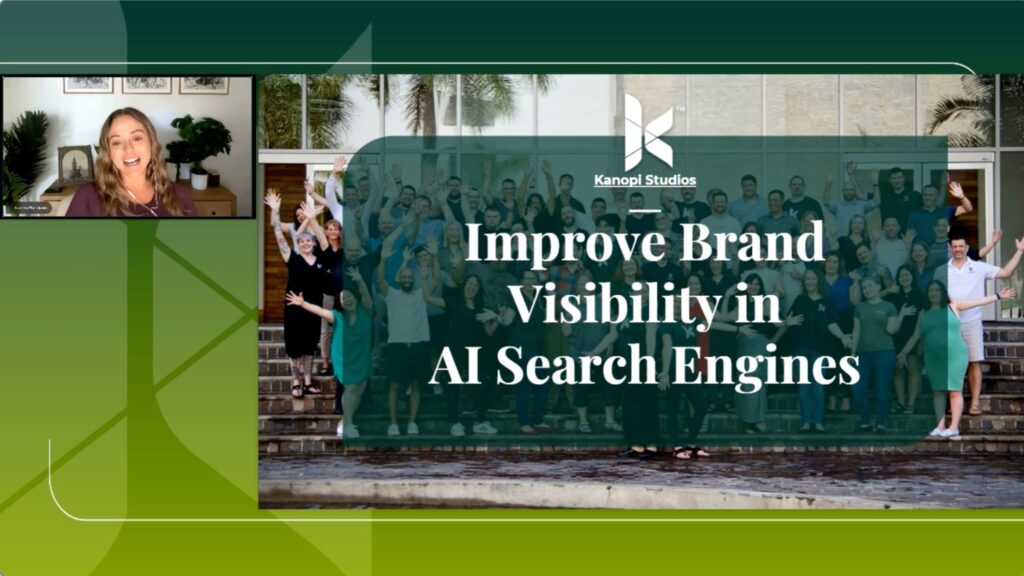
In this 60-minute session, Kanopi’s Lauren Chervinski breaks down exactly how modern AI engines decide which brands to surface, cite, and recommend, and the practical system you can use to become one of them.