



Your healthcare or hospital website is the vital link connecting community members with the essential medical services they need to lead healthy lives. Your website is a critical launch point in the patient journey—studies show that over 60% of consumers use the web to choose a new healthcare provider or search for a service or care option, such as urgent care or imaging services.
Take a look at this example patient journey illustrating the key role healthcare websites play in transforming website visitors into patients:
Patient Journey
Step 1 of 4Search results for “best dermatologist…”
Premium Skin Care Clinic
Board-certified experts. Book now.
ClearSkin Dermatology
Rated #1 for patient satisfaction. Same-day appointments.
Your Skin Deserves Expert Care
We combine medical excellence with a luxury patient experience.
Complete Your Booking
However, your organization might not have the capacity or expertise to turn your digital home into a comprehensive resource that effectively serves your community. Working with a healthcare web design company can provide the support you need to continue delivering high-quality online experiences to your audience.
This guide compares the top healthcare web design agencies to help your healthcare organization find the right fit for your digital needs, covering:
- 9 Best Healthcare Website Agencies to Partner With
- Top Healthcare Web Design Companies: FAQs
- How to Choose the Right Service Provider for Your Needs
9 Best Healthcare Website Agencies to Partner With
| Company | Best For | Target Audience |
| Kanopi Studios | High-touch, mission-driven partnership | University medical departments, health foundations, and specialized health networks |
| Design de Plume | Inclusivity-powered design | Hospitals and health centers seeking inclusive, community-driven communication |
| Modea | Digital “front door” engineering | Large-scale hospitals, healthcare systems, and payors |
| Hedy & Hopp | Privacy-first marketing | Multi-location providers, health plans, and hospitals needing proven ROI |
| Intrepy Marketing | Private practices and surgical centers | Specialty medical practices (Orthopedics, Med Spas, etc.) and solo providers |
| Windmill Strategy | Medical device and life science companies | B2B MedTech and life science manufacturers |
| Practice Builders | Data-driven practice growth | Private clinics, urgent care centers, and dental/specialty providers |
| Supreme Optimization | Technical life sciences and biotech | Science-heavy companies in life sciences, pharma, and health tech ecosystems |
| RainCastle | Biotech branding and investor design | Biotech startups and established life science brands |
1. Kanopi Studios

Location: Kanopi operates remotely, with a team spread across North America.
Best For: A high-touch, mission-driven partnership
Target Audience: University medical departments, health foundations, hospitals, and specialized health networks
Services Overview: Kanopi’s healthcare web design services are built on a philosophy that medical websites should be easy for everyone to use, from patients to content editors to healthcare providers. The Kanopi team prioritizes intuitive user interfaces, accessible functionality and content, and mobile-friendliness. Additionally, every healthcare website Kanopi builds is fully HIPAA- and at least WCAG 2.1 AA-compliant.
Key healthcare web design services include:
- Research and strategy: Every web project starts with discovery and research for a deep understanding of your target audience. This ensures that your website speaks to your users’ needs, no matter who they are.
- Design, user experience, and content: Kanopi creates engaging, accessible, and user-friendly healthcare content that simplifies the visitor experience and deepens audience relationships.
- Web development: Kanopi’s engineers bring your website to life with essential features and functionality, from online patient portals to location maps.
- Web support: The Kanopi team partners with you to drive long-term success, continually enhancing your website with security updates, feature upgrades, and revitalized navigation.
Here’s a snapshot of how Kanopi approaches patient-first design for healthcare clients. We turn messy user interfaces into clean, engaging, patient-first digital experiences.
Plus, 97% of Kanopi’s clients return year over year, demonstrating the team’s lasting commitment to digital healthcare success.
2. Design de Plume
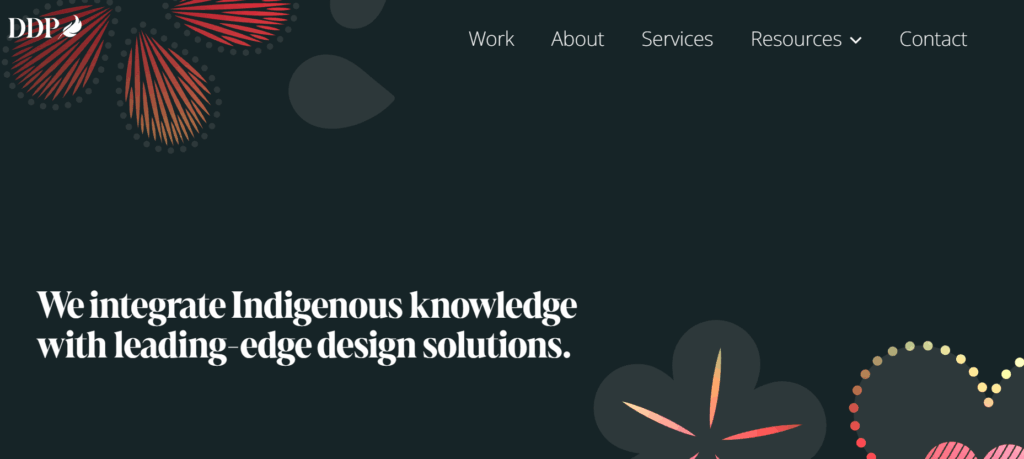
Location: Canada and the U.S.
Best For: Inclusivity-powered design
Target Audience: Hospitals, health centers, and public sector organizations that serve diverse or vulnerable communities.
Services Overview: Design de Plume’s services are fueled by a commitment to inclusivity and honoring indigenous traditions. Their services include strategy, branding, website design, and campaigns. Some of their healthcare clients include the Johns Hopkins Center for Indigenous Health and the Maamwesying Ontario Health Team (MOHT).
3. Modea
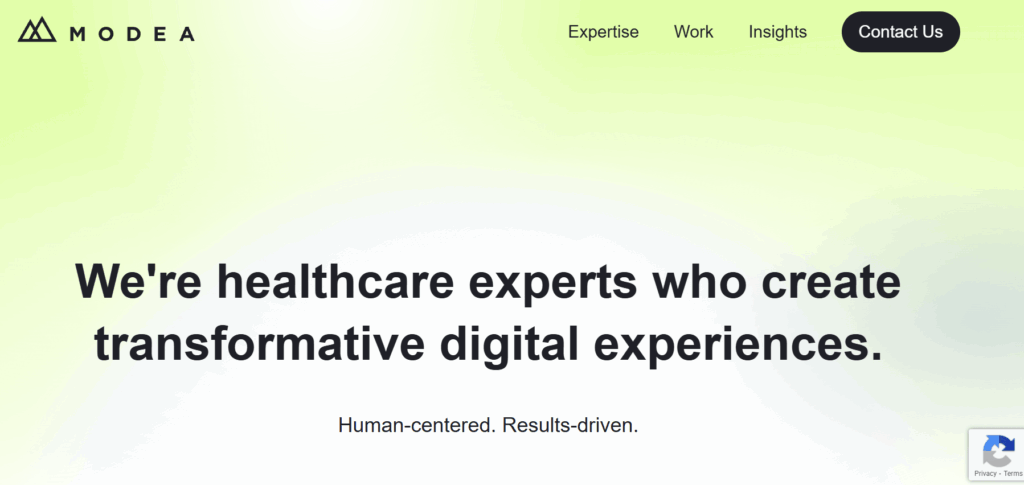
Location: Headquarters in Blacksburg, VA
Best For: High-end digital “front door” product engineering
Target Audience: Large health systems and payors seeking sophisticated digital consumer experiences.
Services Overview: Modea partners with healthcare organizations to build and optimize their online resources. Their services include digital strategy, UX design, web development, electronic health record (EHR) integration, and HIPAA compliance. Their work has helped clients increase website conversions, site speed, and digital revenue.
4. Hedy & Hopp
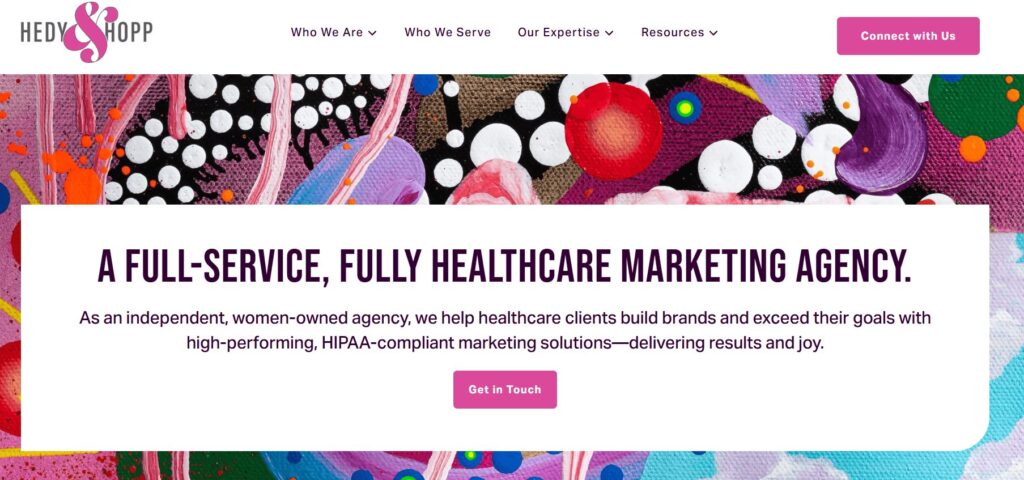
Location: Remote operations
Best For: Privacy-first marketing and HIPAA-compliant attribution
Target Audience: Large health systems, payors, and multi-location providers who need to prove marketing ROI.
Services Overview: Hedy & Hopp is a full-service digital marketing agency for healthcare organizations. They can step in at any point to support healthcare websites, whether they need a full rebuild or optimization. They can also build a robust marketing strategy that sets up your healthcare organization for long-term growth.
5. Intrepy Healthcare Marketing
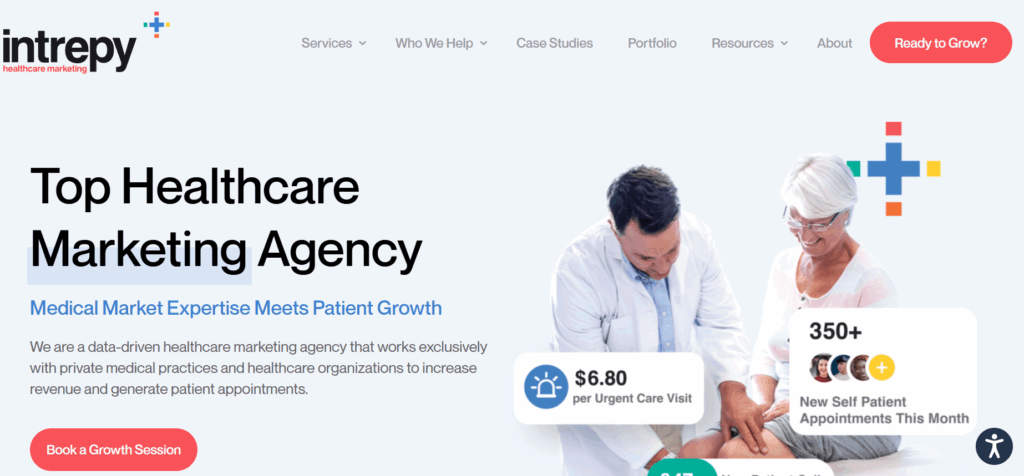
Location: Based in Orlando, FL.
Best For: Private practices and surgical centers
Target Audience: Medical practices and solo providers
Services Overview: Intrepy takes a data-driven approach to healthcare marketing, leveraging real-world experience to provide tailored services that healthcare organizations need. Their services include medical SEO, web design, video production, paid advertising, and more. Clients have seen increases in organic website traffic and appointment booking after working with Intrepy.
6. Windmill Strategy
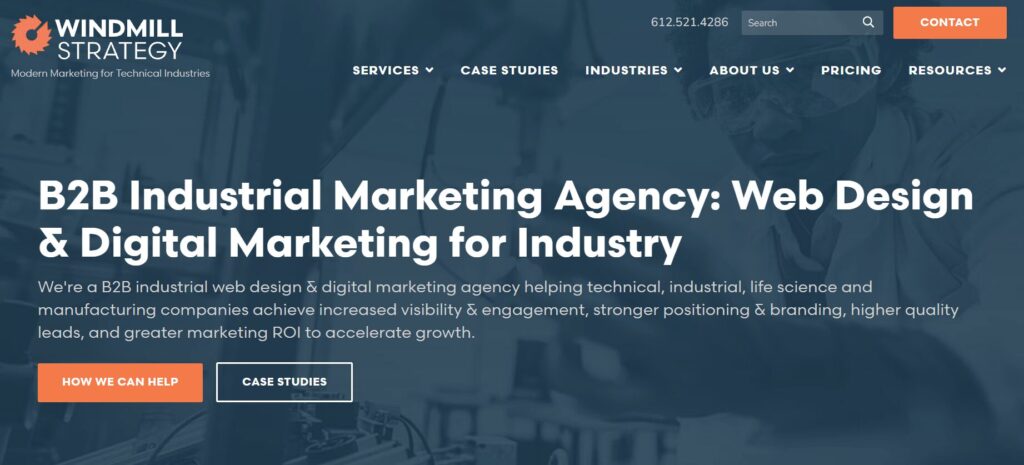
Location: Based in Minneapolis, MN, with clients across the U.S.
Best For: Medical device and life science companies
Target Audience: B2B MedTech
Services Overview: Windmill Strategy provides digital marketing services to B2B marketers with complex offerings. They help medical businesses establish leadership in their sector, showcase their offerings more effectively, and generate leads. They also build websites for life sciences organizations that speak to many audiences, from healthcare professionals and scientists to patients.
7. Practice Builders
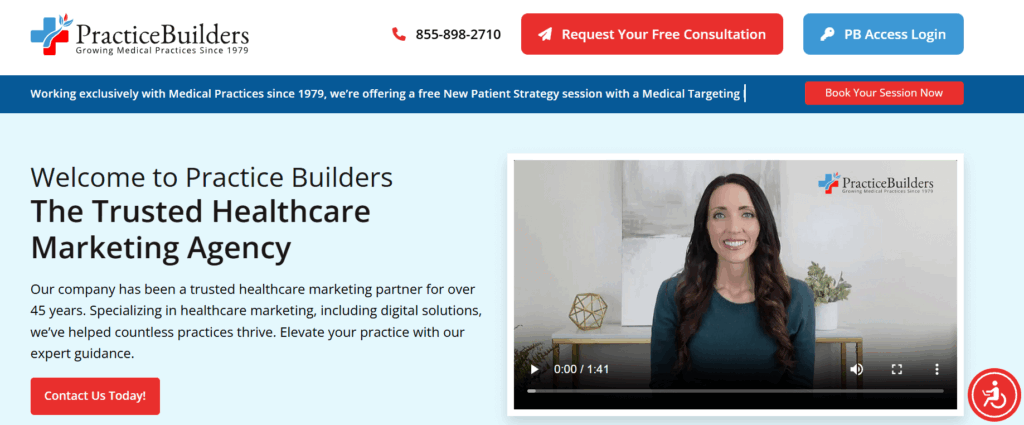
Location: Headquarters in Durham, NC
Best For: Data-driven practice growth
Target Audience: Small-to-medium size clinics
Services Overview: Practice Builders has been in the healthcare digital marketing space for over 45 years. They help practices grow through web design, reputation management, SEO, and social media marketing. Their clients range from medical offices to dental practices and other specialties.
8. Supreme Optimization

Location: Remote/global capabilities
Best For: Technical life sciences and biotech
Target Audience: Scientific organizations needing Ph.D.-level strategists to communicate complex healthcare or life science products.
Services Overview: Supreme Optimization is a full-service marketing agency for life science organizations. Their global team includes 70+ Ph.D. scientist-marketers, ensuring they have deep knowledge of life science topics. Their team helps orgs maximize their ROI through smart UX and data-driven intelligence.
9. RainCastle Communications
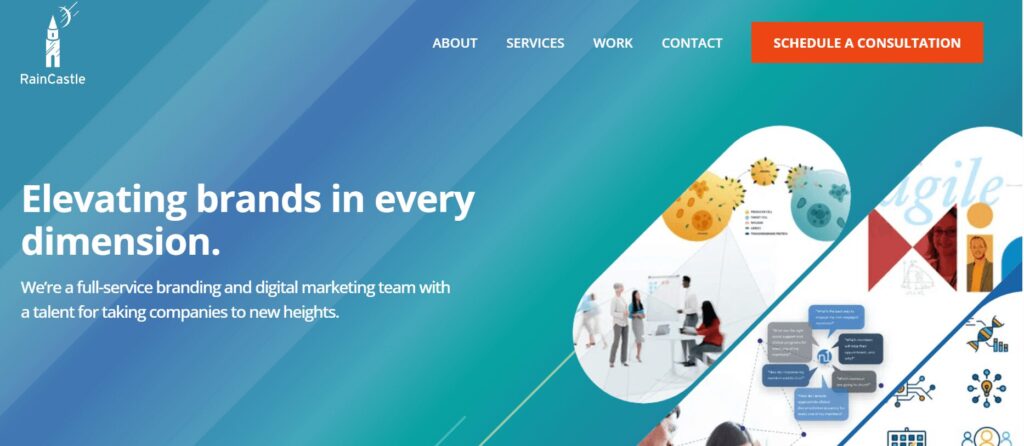
Location: Headquarters in Needham, MA
Best For: Biotech branding and investor-focused design
Target Audience: Biotechnology
Services Overview: RainCastle Communications builds B2B websites for life sciences, healthcare technology, and professional services. They take a strategic approach to web optimization, from thoughtful discovery and design to ongoing optimization. Their industry expertise allows them to achieve strong results while reducing risks.
Top Healthcare Web Design Companies: FAQs
How does healthcare web design differ from standard web design?
Healthcare sites face significantly higher stakes than other sectors; they must balance complex regulatory compliance (HIPAA, ADA) with a patient-first UX that reduces anxiety and is easy to use for web visitors who are often stressed or in a hurry.
Why is industry-specific experience so important?
Experienced agencies already understand clinical workflows, medical SEO, and the specific trust signals needed to convert a visitor into a patient, so they don’t need to be brought up to speed on the ins and outs of your industry.
What is the average timeline for a healthcare website build?
Timelines depend on scope, but they generally range from a few months to significantly longer for enterprise-level organizations with complex integrations, such as EHRs and patient portals.
What are the non-negotiable compliance standards?
Any reputable agency must guarantee HIPAA compliance for data privacy and Web Content Accessibility Guidelines (WCAG) 2.1 Level AA accessibility standards.
How do agencies protect sensitive patient information (PHI)?
Top firms implement SSL encryption, secure data storage, and encrypted form submissions to ensure that any data transmitted, from appointment requests to bill pay, is protected from breaches.
What features do patients value most on a healthcare site?
Data shows that 94% of consumers prioritize easy navigation on the websites they use. Other essential healthcare site features include intuitive search, mobile-friendly appointment scheduling, provider directories, and secure patient portals.
Why is mobile-first design critical in healthcare?
With over 64% of web traffic originating from mobile phones, patients need to be able to find directions or book care while on the go, often while juggling other stressful tasks like childcare and jobs. That means a mobile-friendly interface is critical to help them complete essential tasks.
How is accessibility handled for diverse patient needs?
Agencies should follow WCAG guidelines by creating designs that facilitate keyboard navigation, provide high color contrast for the visually impaired, are screen reader compatible, and offer clear, jargon-free content.
How much does a professional healthcare website cost?
Pricing varies widely based on the number of pages, custom features (such as telehealth integrations), and the level of ongoing support required.
How can we measure the ROI of a new website?
A top-quality agency will track specific metrics such as increases in new patient inquiries, online appointment bookings, and improved search engine rankings for key medical terms. You can use this data to evaluate whether your site is serving your goals or whether you need to adjust your strategy to improve outcomes.
How to Choose the Right Service Provider for Your Needs
- Ensure specialty alignment. If your healthcare organization requires specialized functionality, ensure the web design provider you work with can accommodate your needs. For example, a pediatric care clinic needs a balance of professional trust for parents and a friendly, approachable aesthetic. This often requires multilingual content options and quick links for vaccine schedules or dosage charts.
💡 Pro Tip: Ask for a “Design Persona” review. A provider should be able to explain how their design choices specifically appeal to both the logical needs of a parent/patient and the emotional comfort of the user.
- View portfolios. Explore case studies and client stories from potential providers to see whether their services and deliverables align with your requirements. Verify that their past work includes high-quality medical imagery and engaging video storytelling. Also, browse their past projects on a mobile device to ensure complete mobile compatibility.
💡 Pro Tip: Don’t just look at the homepages. Navigate to a deep resource page on your phone (e.g., a dosage chart or provider directory). If you have to pinch and zoom to read it, they aren’t truly mobile-optimized.
- Ask for references. Don’t just take their word for it—ask potential agencies for references from past clients so you fully understand their approach with healthcare providers. For instance, you may ask a reference, “How did the agency handle situations where a timeline needed to be extended due to a new compliance requirement?”
💡 Pro Tip: Ask this exact question: “Can you describe a time this agency caught a compliance or security risk before you did?” This reveals whether they are proactive partners or just order-takers.
- Verify HIPAA compliance and security standards. Ensure the provider you choose complies with digital HIPAA guidelines and offers top-level security standards. Confirm they implement multi-factor authentication (MFA) for all logins, SSL encryption for every form, and secure off-site backups.
💡 Pro Tip: If a provider says, “Our hosting is HIPAA-compliant, so your site is too,” keep looking. HIPAA compliance requires specific encryption at the application level (how the forms handle data), not just where the files are stored.
- Ensure custom accessibility. Ensure custom accessibility. Your web design partner should be able to tailor your site’s accessibility to your unique audience. For example, if your organization serves populations with low vision and blindness, your web provider should be able to build your website to accommodate these needs, including high color contrast, audio descriptions, and other essentials.
💡 Pro Tip: Ask for an accessibility audit report from a previous project. If they can’t produce one, they likely aren’t testing for screen readers or low-vision users.
- Ask about EHR integration. Ask specifically if they have integrated with your exact EHR system, such as Epic, Oracle Health, PracticeSuite, or athenaOne, as the technical lift varies significantly between platforms. Ensure they can seamlessly link to or embed patient portals so users can access test results and medical history without a confusing login experience.
💡 Pro Tip: Integration isn’t “one size fits all.” Ask: “Do you use a native API integration for [Epic/Oracle], or are you just skinning an external login page?” The latter often leads to a disjointed user experience.
- Explore support options. Determine the level of ongoing support your provider will offer your organization to ensure continued success. Ask about their guaranteed response time for critical security patches versus general content updates.
💡 Pro Tip: Distinguish between “Response Time” (we saw your email) and “Resolution Time” (the bug is fixed). Ensure your service-level agreement (SLA) defines both for critical security patches.
- Inquire about results tracking. Evaluate how providers measure website performance and report back to clients. Beyond traffic, they should track online appointment booking rates, newsletter sign-ups, and the “Success Rate” of your internal search bar.
💡 Pro Tip: Ask them to set up “Conversion Funnels” that track how many visitors to a service page actually complete an “Appointment Request” form.
Wrapping Up
Finding the right web design provider for your healthcare organization is as much about relationship building as it is about wireframes and branding strategies. When you can find an agency that truly cares about your organization, deeply understands its needs, and is devoted to its success, you can build an online presence that furthers your healthcare mission.
For more information, check out these additional healthcare web design resources:
- 12 Best Healthcare Website Design Examples & Why They Work. Explore effective examples of healthcare website designs for inspiration as you collaborate with your web design provider.
- Healthcare Web Development: Your Complete Guide for 2025. Learn the basics of what goes into developing a healthcare website and how you can ensure that your site is secure and high-performing.
- How to Use Healthcare Content Marketing to Drive Engagement. Discover tips for more effective content marketing, including leveraging strategic personalization and crafting compelling calls to action.