

Search optimization has changed. Traditional SEO still matters, but it’s no longer enough on its own. Today, your site also needs to perform well in generative search engines and AI-driven tools like ChatGPT, Perplexity and Google’s AI Overviews. That’s where GEO (Generative Engine Optimization) and AEO (Answer Engine Optimization) come in.
At Kanopi, we don’t treat SEO, GEO and AEO as separate strategies. They all depend on the same foundation: a fast and crawlable site with a clear and accessible structure for people and machines. When you build that foundation well, your content can perform in traditional search and AI tools. It can also adapt to what comes next.
Many of our clients already think this way. They want Drupal AI consulting and ongoing optimization, not one-time fixes.
Here’s how we approach this in practice, with real examples from our work.
Start with the Technical Foundation
Strong optimization always begins with the basics. If search engines or AI systems can’t reliably crawl and understand your site, everything else is harder.
At this stage, our work typically includes:
- Auditing the site’s search foundation
- Crawlability
- Performance
- Templates
- Metadata
- Internal linking
- Accessibility
- Finding and fixing issues that suppress search performance
- Broken links
- Orphaned pages
- Duplicate content patterns
- Redirect gaps
- Low-value pages that dilute crawl budget
- Reviewing CMS structure
- Drupal templates
- WordPress templates
- Content models that support consistent indexing and interpretation
This work isn’t flashy, but it is essential. It creates the conditions for SEO, GEO and AEO to work together instead of competing with each other.
Make Content “Answer-Ready” for GEO and AEO
AI tools tend to reward content that answers questions clearly and quickly. However, that doesn’t mean dumbing content down. It means structuring it so the core message is easy to extract, which starts with strong brand and entity signals that reinforce credibility. Key pages need to stay fresh and consistent and the format has to work for both crawlers and AI systems.
To support this, we focus on practical changes that make content easier to understand and easier to trust. This includes:
- Restructuring key pages so they answer the primary question early; we use clear headings and short sections that readers can scan
- Strengthening entity clarity and relationships (for example: between people, departments, research areas, programs and initiatives)
- Reducing ambiguity so AI systems can connect concepts accurately and return answers with proper context and attribution
This helps content perform better in AI-generated answers, featured snippets and zero-click results while still encouraging users to visit the site for deeper information.
Add Machine-Readable Signals Without Overdoing It
Search engines and AI systems rely on structured signals to understand what your content represents. We add these carefully and intentionally.
This usually includes:
- Implementing or refining structured data where it provides real value, such as:
- Organization
- Person
- Article or news
- Events
- Standardizing key on-page signals:
- Titles
- Descriptions
- Canonical patterns
- Open Graph metadata
- Reducing conflicting signals so platforms interpret your content consistently
The goal is clarity, not complexity. More markup isn’t always better.
Manage Bot Traffic So Performance Stays Stable
AI crawlers and aggressive bots can put real strain on sites, especially on search results and listing pages. We treat bot management as part of optimization, not just security.
Here’s how we manage bot traffic:
- Blocking malicious bots as early as possible, ideally at the CDN or WAF layer before requests reach your Drupal, WordPress or the database
- Applying rate limiting and bot controls to reduce resource strain from aggressive crawlers
- Maintaining a robots.txt strategy that supports SEO while limiting unnecessary crawling
- When appropriate, implementing an llms.txt (proposal-level, community-led) approach to guide some AI crawlers towards key pages to also reduce unnecessary crawling
We also review bot patterns regularly and adjust controls as new crawlers emerge.
Measure, Iterate, and Improve Over Time
SEO, GEO and AEO aren’t one-time projects. They improve through iteration.
Ongoing work often includes:
- Using analytics and search data to identify high-value queries, zero-result patterns and content gaps
- Maintaining an optimization backlog and delivering improvements incrementally
- Folding this work into ongoing support, alongside performance, accessibility and analytics improvements
This avoids disruptive overhauls and keeps progress steady.
Real Examples from Our Work
Kanopi Studios
We’ve applied this same approach to our own site. We clarified service language, improved content structure and added machine-readable signals for AI discovery.
Today, roughly one-third of our new inbound leads originate from ChatGPT and similar tools. GEO and AEO are definitely driving real business outcomes.
COIT
For COIT, we focused on structuring service pages and how-to content to answer common user questions directly. This increased visibility in AI-generated answers and featured snippets, while still guiding users back to the site. We also supported franchise-related content so it was easy to discover and accurate across both traditional search and AI platforms.
San Francisco International Airport
For SFO, we supported SEO and emerging AEO strategies on a large, high-traffic site. Our work focused on performance, content clarity and structured data so users could quickly find authoritative answers about services and operations.
Centre for Digital Media
For the Centre for Digital Media, we improved the sitemap and clarified user pathways, strengthening information architecture and internal linking. This improved discoverability and reinforced SEO fundamentals that also support AI interpretation.
Ongoing Support Clients
Technical SEO is a recurring part of many support engagements. It often works alongside performance tuning and continuous improvement.
This is where SEO, GEO and AEO work tends to live and mature over time.
How clients are using AI on their websites today
AI tools are still emerging for many organizations, but early adopters are already seeing practical benefits.
PEN America
PEN America publishes a high volume of image-based content. Manual alt text creation was slow and inconsistent. We implemented AI-powered alt text generation directly into the editorial workflow. Editors can review and refine suggestions, reducing manual effort while improving accessibility compliance. It also speeds up publishing.
Settle In US
Settle In US serves people navigating complex immigration information. Long, text-heavy pages were difficult for some users. We implemented text-to-speech using Eleven Labs, improving accessibility and making critical content easier to consume.
Exploratorium
Exploratorium manages a large and diverse content library. The keyword search made discovery difficult. We implemented Algolia with AI-based semantic search, allowing users to find relevant content even when their terms didn’t match exact keywords. This improved discovery and engagement across the site.
A solid foundation helps your content be found.
SEO, GEO and AEO aren’t separate checklists. They’re different expressions of the same goal: making your site easy to understand, easy to access and genuinely helpful.
With a solid foundation, you can expand your content strategy so it performs across search engines, AI tools and future platforms without constant reinvention. Visibility also comes from getting your best content cited and discussed beyond your site. That can include digital PR, partnerships, guest contributions and community-first participation where your audiences already ask questions. Generative tools often draw from both trusted publishers and community platforms, such as YouTube or Reddit. A strong off-site strategy can build your credibility and increase how often your content gets referenced.
If you’re moving in that direction, ongoing optimization and AI-aware strategy can help you gain more value.
Want more? We held a webinar that’s related to this.
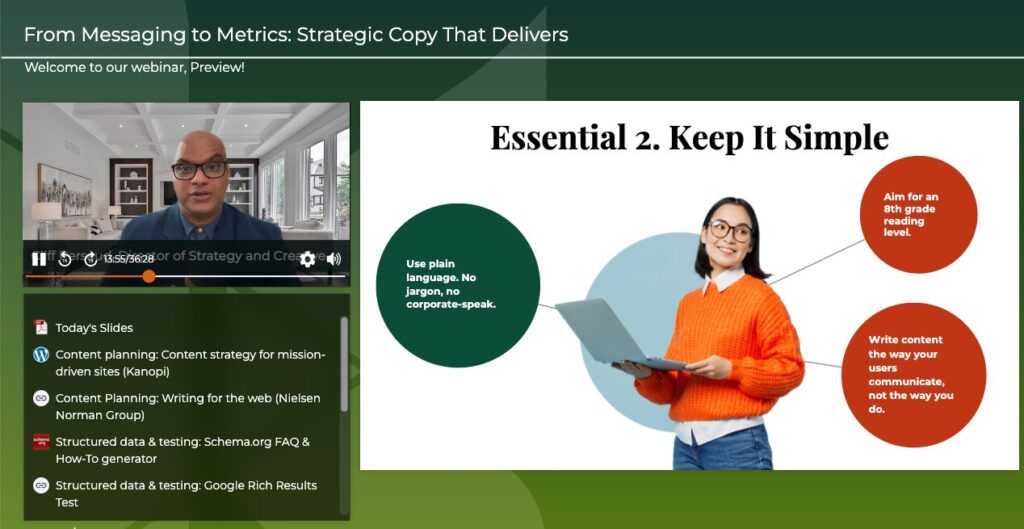
Want to dig deeper? Kanopi’s Cliff Persaud gave a webinar called “From Messaging to Metrics: Strategic Copy that Delivers” (36 minutes) that covers the best practices for copy in the age of artificial intelligence.