







A few years ago, every organization needed a search engine optimization strategy (and they still do). Now there’s a new must-have climbing just as fast: a plan for artificial intelligence (AI).
This isn’t the part where we warn you that the robots are coming for your job. They’re not. What’s changing is less dramatic and more useful: how people find information, how content gets made, and what visitors expect when they arrive. The opportunity is to make your organization easier to find, your team more effective, and your website more helpful.
We think about it in three parts:
1. Get found when the search box is a chatbot.
The way people search is changing fast. Instead of typing keywords into Google, people ask ChatGPT, Gemini, Claude, and Perplexity full questions. Around a third of desktop searches now show a Google AI Overview before the blue links appear, and when that happens, far fewer people click through.
Sit with that: it changes the whole funnel. Your next visitor might never scroll a page of results, and might just ask a chatbot and take it at its word. They may never visit your home page to learn about you, and instead may rely on results from whatever large language model (LLM) they are using.
To stay visible, you need to practice Generative Engine Optimization (GEO). Your content must be clear, trustworthy, well-organized, and incredibly easy for an AI model to extract.
To make a website AI-friendly, focus on these technical steps:
- Open your doors to AI crawlers. Audit your robots.txt file to ensure you aren’t accidentally blocking legitimate AI bots (like ChatGPT’s OAI-SearchBot) from reading your site. An AI system cannot cite content it cannot reach.
- Write answer-first content. Place the core answer to a user’s question in the first 40 to 60 words of a page or section. AI models prioritize easily extractable answers, so giving them a clean summary right away increases your chances of being cited.
- Add structured data. Deploy schema markup (like FAQPage, Article, or Organization tags) to help LLMs clearly understand your brand and connect the dots about your expertise.
2. Work smarter, with your people in charge.
The best results come from people and AI side by side. AI handles the grunt work: drafting, summarizing, floating ideas, writing image descriptions, and speeding up repetitive tasks. What it can’t do is understand your mission, know your audience, protect your brand, or notice when it’s confidently, cheerfully wrong. That part is still yours.
So we help clients build workflows that keep people in charge, including:
- AI guidelines for content editors
- Brand and tone guardrails
- Reusable prompts and AI skills that package your organization’s instructions, standards, and workflows.
- Editorial sign-off and accessibility reviews
- Training on when to lean on AI, and when not to
A good prompt can help with a single task. But when your team repeats that task regularly, you shouldn’t have to start from scratch every time. AI skills let you package instructions, brand guidelines, reference materials, and workflows into reusable tools that your team can share. For example, you might create a skill that reviews content against your editorial standards, checks accessibility requirements, or prepares a first draft using your organization’s voice. This makes AI-assisted work more consistent and easier to maintain, while keeping people responsible for reviewing the results.
Here’s what that looks like in practice. The Kanopi team worked with PEN America on a recent migration that needed alt text for thousands of images. By hand, that delays launch by weeks. Instead, AI drafted every description, and our team reviewed, edited, and approved each before it went live. The site launched on time, accessibility intact. AI handled the volume, while people did the thinking.
3. Build a website that does more of the work.
AI is also changing what your website can do for visitors. At Kanopi Studios, we’re helping clients integrate smart tools to enhance the user journey, adding features like:
- AI-powered search that understands questions, not keywords
- Chat assistants that guide visitors straight to answers
- Smarter content recommendations
- Better ways to surface expertise buried in a big site
Upgrading to an AI-powered search tool (such as Algolia for Drupal or WordPress) allows your site to understand natural-language questions rather than just matching exact keywords. You can also implement chat interfaces that guide visitors straight to the answers they need, surfacing expertise that is normally buried deep within a massive site.
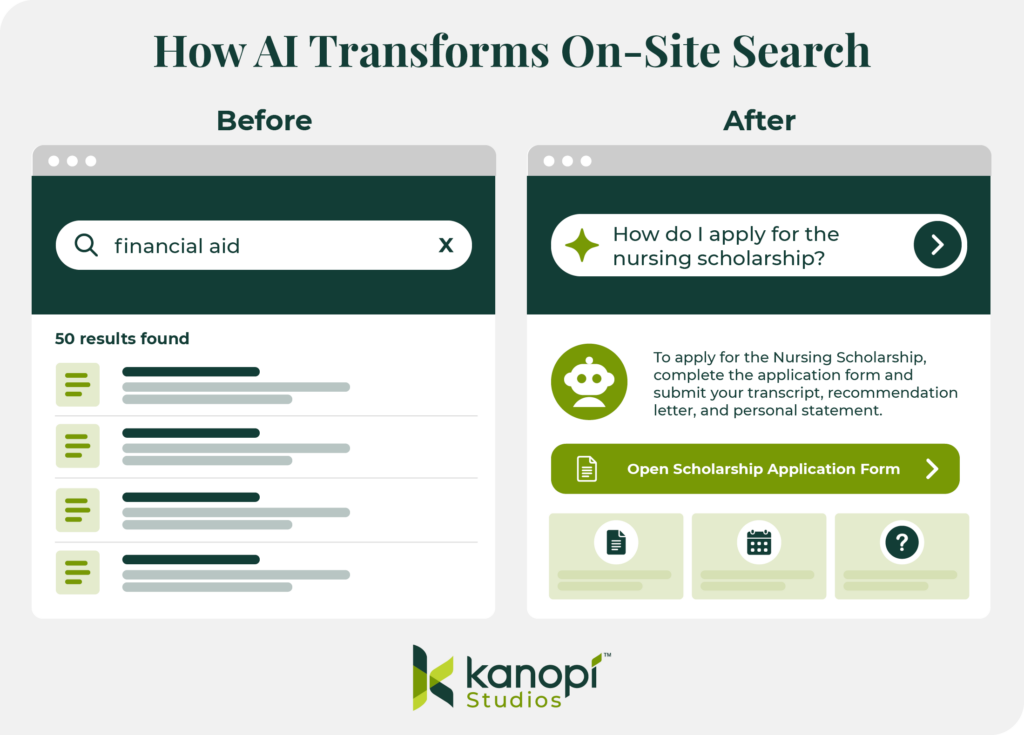
Picture a student on an academic program page who opens search and types, “What are the requirements for this program?” A traditional search engine shrugs and returns broad admissions pages. A well-built AI experience knows that “this program” refers to the page they’re on and returns the exact requirements with links to the source. It feels less like digging through a filing cabinet and more like being shown around by someone who knows the place.
Alt: Graphic showing traditional vs. AI-powered onsite search. The “before” side shows an internal search function with a list of links, whereas the “after” side shows the user with the information they need to take their next step.
Behind the scenes, we lean on AI too.
We put AI to work in our own process as well, always to support our people rather than stand in for them. Take content strategy. Recently, we reviewed more than 5,300 pages for a client. A first pass at that scale used to take weeks; with AI, we did it in hours.
Then our strategists do the part that counts, asking whether each page still earns its place, whether it should stay, change, or go, where the accessibility and SEO gaps are, and what might be confusing people.
It’s the same in development: AI handles the repetitive coding and testing, which frees our developers for the harder, more interesting problems, which is where the real value lives anyway.
So, where do you start?
There’s a lot of noise about AI. Some are sure it’ll replace every job; others won’t touch it. The truth sits in the middle: AI is powerful, but only as good as the person holding it. You don’t have to do everything at once. Most organizations begin with a few honest questions:
- Can people find us in an AI-first world?
- Are our teams using AI safely and well?
- Where could AI make our website more useful?
- How do we move faster without letting quality slip?
The answers look different for everyone, and that is perfectly fine. AI is already reshaping how people search, work, and learn. Partner with Kanopi Studios to run a comprehensive AI readiness audit of your website, and let us help you build a strategy that puts your people and your audience at the center.