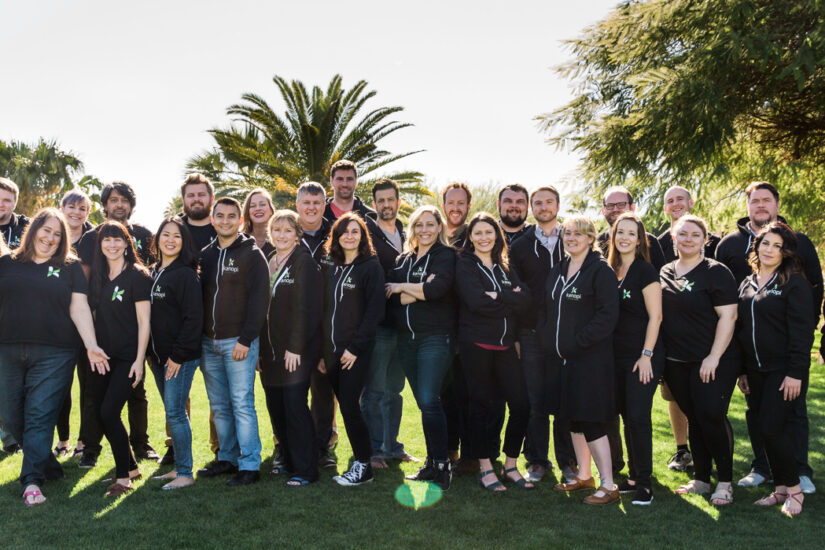

The modern digital landscape demands web architectures that are as fast and flexible as they are robust. To meet this need head-on, Kanopi Studios recently acquired Chapter Three, a San Francisco-based Drupal agency with a 20-year history of open-source innovation and community leadership.
This acquisition was driven by a clear strategic goal: merging Chapter Three’s elite technical stack, particularly their pioneering expertise in Next.js and decoupled architectures, with Kanopi’s holistic, strategic design-to-support services. Together, we provide an end-to-end partnership for organizations ready to modernize and scale their digital presence.
But why are so many enterprise brands making the leap to decoupled platforms? Whether you are looking to future-proof your technology stack or deliver lightning-fast, omnichannel user experiences, understanding how these tools work together is the first step.
In this guide, we break down the need-to-know fundamentals of Next.js and headless Drupal. We’ll explore why this powerful combination is winning over enterprise brands, and share how Kanopi’s newly expanded team has successfully leveraged these cutting-edge frameworks to build high-performance digital solutions.
What is Headless Drupal and Next.js? Key Definitions
What is Decoupled/Headless Drupal?
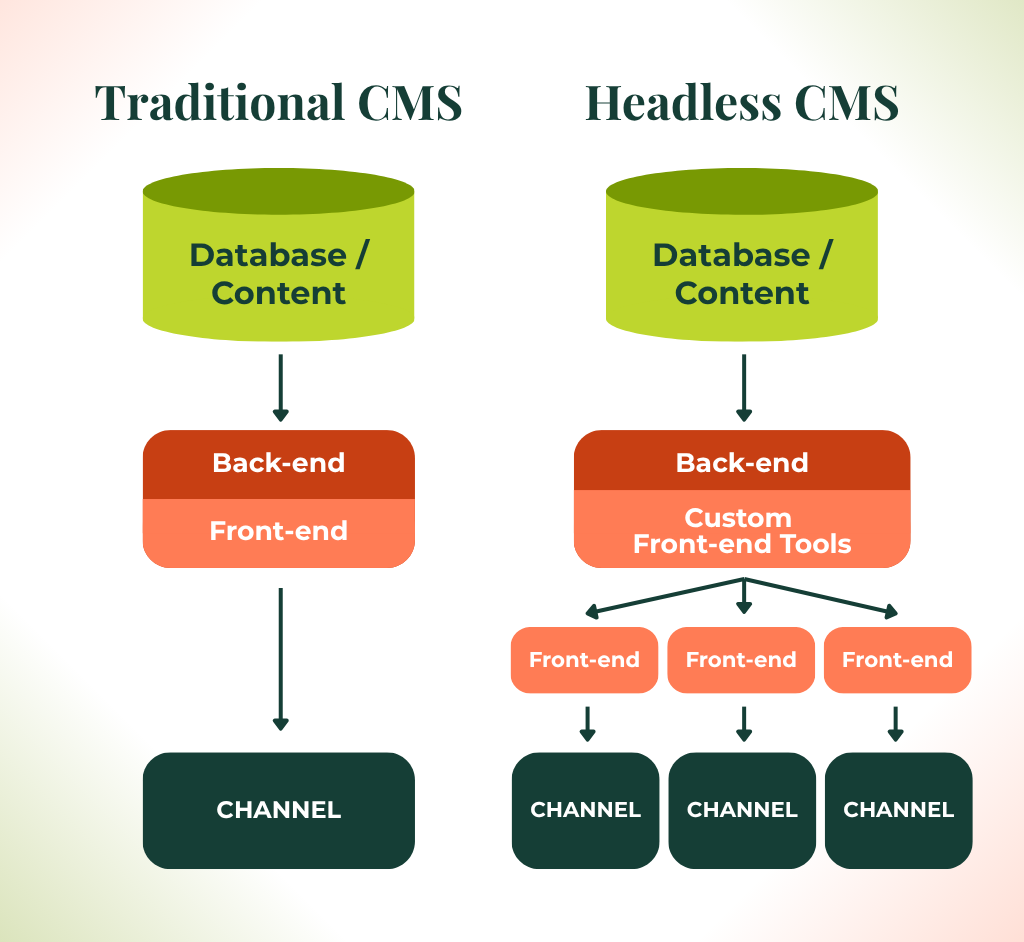
Decoupled or headless Drupal is a modern web architecture that separates the backend content management system (where editors input data) from the frontend presentation layer (what visitors see). This separation offers organizations greater flexibility, improved performance, and enhanced security compared to traditional, monolithic CMS setups.
What is Next.js?
Next.js is a powerful frontend React framework that allows developers to build blazing-fast, highly secure, and dynamically scaling user interfaces. It offers features such as server-side rendering (SSR) for optimized page load performance and built-in file system routing to simplify navigation in complex web applications.
What is Next.js for Drupal?
Next.js for Drupal is the premier open-source technology that bridges Drupal’s robust backend database and a Next.js frontend, providing expanded API capabilities and an unmatched developer experience.
Why Headless Drupal Architecture is a Game-Changer for Digital Leaders
Adopting any new technology is a significant investment that must result in a high ROI. For enterprise brands, moving to a headless Drupal and Next.js architecture is a strategic business decision. These frameworks offer the following tangible business and marketing benefits that directly impact your bottom line:
- Blazing-fast speed and conversion rates: Static generation via Next.js removes load-time lag, keeping anxious or busy users engaged and directly boosting conversion rates.
- Total security and risk reduction: Because the database (Drupal) is separate from the frontend, there is no direct path for attackers to access your sensitive data, drastically reducing DevOps risk.
- A content editor’s dream experience: Going headless doesn’t mean content editors lose control. With modern headless Drupal, internal marketing teams still enjoy intuitive editing and flexible component tools.
This architecture eliminates the traditional trade-offs among marketing agility, enterprise security, and user experience. It provides a resilient, scalable foundation that allows digital leaders to innovate faster, deploy content seamlessly across multiple channels, and adapt quickly to whatever the market demands next.
Powering Massive Digital Ecosystems: Our Work with the National Association of Realtors (NAR)
To truly understand the power of a headless architecture, you have to see it perform at scale. The National Association of Realtors (NAR) is a prime example. As a prestigious, large-scale client that joined Kanopi’s portfolio following the Chapter Three acquisition, NAR’s recent website transformation illustrates exactly why enterprise organizations are turning to Next.js and decoupled Drupal.
The NAR website operates on a massive scale. It serves as the digital cornerstone for the real estate industry, delivering critical news, training, and activities to hundreds of thousands of members.
The Challenge: A Looming EOL and Massive Complexity
Facing the end of life (EOL) for Drupal 7, NAR needed more than just a platform upgrade; they needed to future-proof their digital infrastructure. Their existing self-hosted site contained ten years of complex, heavily knitted-together content and assets. They also had complex third-party integrations, advanced editorial workflows, and a pressing need to reduce the burden of managing their own complex hosting hardware.
The Solution: A True Decoupled Transformation
Our team spearheaded a complete reimagining of the platform using Next.js for Drupal. This ambitious project had three main pillars:
- Large-scale migration: Safely transitioning ten years of Drupal 7 content and optimizing the architecture for Drupal 11.
- Refactoring integrations: Rebuilding complex third-party tools, including SSO/Auth0 for role-based authentication, enterprise media providers, and advertising suites (Tealium, Adobe, Google).
- A Next.js frontend: Completely rebuilding the presentation layer to run on Vercel, driven by powerful APIs.
The Results: Unmatched Scalability and Security
By separating the backend data from the frontend presentation, the new architecture completely modernized NAR’s digital footprint with:
- Extreme scale: The frontend, powered by Next.js on Vercel, effortlessly handles thousands of concurrent logged-in users while editors continuously push new content throughout the day.
- Zero editorial disruption: Because the Drupal backend retained its intuitive nature and was enhanced with live previews and component templates, the transition required no in-depth retraining for NAR’s editorial staff.
- Bulletproof security: Decoupling the frontend from the Drupal database eliminates direct vulnerabilities.
- Simplified infrastructure: Moving to an API-driven, managed-hosting approach allowed NAR to eliminate complex, internally managed hardware and legacy third-party CDNs.
The NAR platform proves that decoupled architecture is the ultimate, ROI-driven choice for large associations and enterprise-level organizations that require both complex data management and blazing-fast performance.
Frequently Asked Questions About Next.js and Headless Drupal
Why should an enterprise organization choose a headless Drupal architecture over a traditional CMS?
Headless Drupal allows organizations to retain Drupal’s highly secure, robust backend and content modeling while delivering content to a lightning-fast, custom frontend like Next.js. This results in vastly superior loading speeds, improved site security, and the flexibility to deliver content seamlessly across multiple digital channels.
How does Next.js for Drupal improve the web developer and editor experience?
Next.js for Drupal provides native, out-of-the-box integration between Drupal and Next.js, allowing developers to utilize expanded API capabilities without building connections from scratch. Simultaneously, it preserves a user-friendly editor environment, ensuring that marketing teams can easily write, publish, and update content in real-time.
Is Next.js suitable for large-scale professional association websites?
Yes, Next.js is highly recommended for enterprise association sites. Next.js easily handles heavy traffic loads, complex database integrations, and vast amounts of content while maintaining exceptional speed and responsive, mobile-first performance on both desktop and mobile.
Ready to Prepare Your Website for the Future? Let’s Create Together
At Kanopi, our ultimate goal is to help mission-driven organizations and changemakers thrive in an ever-evolving digital world. The combined power of headless Drupal and Next.js gives you the agility to meet changing market demands head-on.
Navigating a transition of this scale requires a partner who understands both the deep technical nuances of decoupled architecture and your business’s strategic goals. With our newly expanded team following the Chapter Three acquisition, we offer the elite engineering required to execute complex platform modernizations, paired with a holistic design-to-support lifecycle that ensures your site performs beautifully long after launch.
Whether you are looking to migrate decades of complex content or dramatically improve your frontend speed and security, we are ready to guide you through the process. Reach out to our expert team today for support. We’ll take great care of your site. But most importantly, we’ll take great care of you.