




Every website project starts with decisions. Which CMS should we choose? What should we keep? What should we change? How do we measure the success of the project?
You wouldn’t build a house without drafting plans for the plumbing and electrical, so why would you do that with a website? In order to reduce risk as well as costs, set up your project for success with thorough upfront planning. It’s the best way to avoid wrong decisions that can add months of work and significant cost.
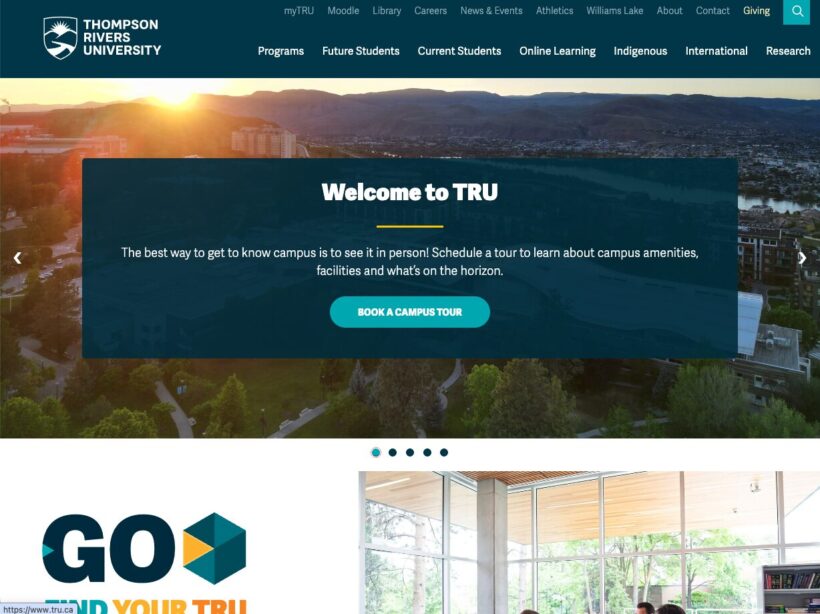
At Kanopi, we never start a project of any size without thorough discovery and research. And one of our recent projects for Thompson Rivers University (TRU) is a great example. TRU came to us with a strategy-only project centred on a deceptively simple question: which content management system (CMS) was the best one for their website moving forward?
TRU’s challenge:
TRU’s website was on a limiting proprietary system. The internal TRU team was anxious and ready to switch to a better solution, and the one thing they could agree on was that they wanted to switch to an open source solution. But they were conflicted about which one to choose. So they spent more than a year debating one question: should their next website be built in Drupal or WordPress?
Each option had supporters, and every discussion created more questions. Before investing in a new website, they wanted confidence they were making the right decision.
That’s where Kanopi came in. After 12+ months of internal debate about how best to move their website forward, they brought us in to help make the call.
They identified several areas where their website was struggling and falling short:
- There were inconsistencies between courses and programs, making the user experience confusing.
- Messaging was also inconsistent across pages.
- Their home page had 12 different pathways, creating decision paralysis for visitors.
- The site lacked a content strategy.
- The page structures were disjointed.
- Permissions were a struggle from a content publishing standpoint.
- Rigid layouts left little flexibility in designs.
The main objective for Kanopi was to help the TRU team decide which open source platform — WordPress or Drupal — would better serve their internal and external audiences. Kanopi was brought in strictly to help with this decision; we didn’t perform any design or development work. Instead, we took a comprehensive deep dive into TRU’s website, their goals and needs, ultimately creating a detailed spreadsheet weighing the pros and cons of each CMS to help them determine which platform would best serve them moving forward.
Turning research into evidence.
Our team ran a thorough research process, using a range of methods to map the University’s needs.
Before recommending a CMS, we needed to understand three things:
- What users needed
- What the University needed
- What each CMS could realistically support
The research — which included surveys, competitive analysis, analytics review, workshops with decision-makers, and audits — identified more than 80 capabilities the future website would need to support in order to meet their goals.
Because Kanopi works extensively in both Drupal and WordPress, we were able to provide an objective recommendation based on the University’s needs instead of promoting one CMS over another. We compared Drupal and WordPress against each of the over 80 pieces of functionality that needed to be considered, everything from federated search to subsite configuration.
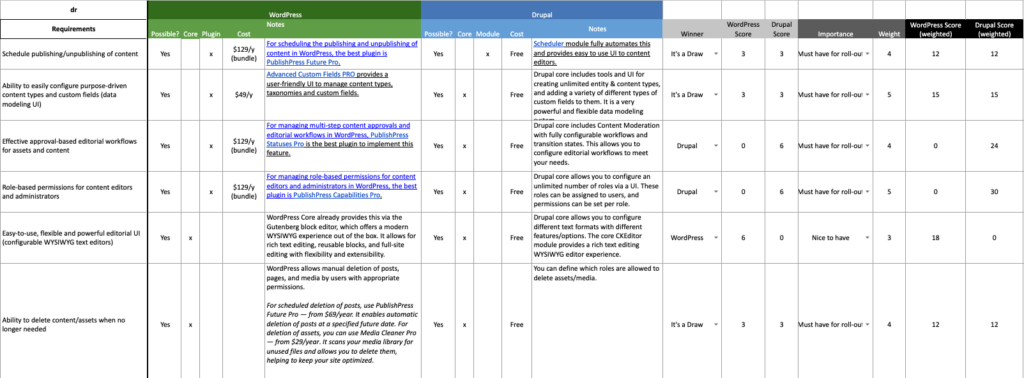
But the biggest step was the next one, which was to take all that research and create a complex spreadsheet that compared and contrasted the pros and cons for both Drupal and WordPress across all the needed functionalities. We also considered which components were native to each CMS, and if not, what the additional costs would be to add those components. We also identified where future costs could increase.
A scoring system was built into the spreadsheet, and we had the TRU team go through each item to determine the weight and importance of each item we identified. Because Kanopi has in-depth expertise in both WordPress and Drupal, we were able to convene a panel of experts for this comparison to avoid bias.
Creating a spreadsheet helped us get to the more important goal, which was to be able to provide TRU with an objective way to review each CMS and create a thorough business case for their decision and give them confidence moving forward.
Data helped bring clarity.
The final scores were closer than many people expected: Drupal scored 1059 while WordPress scored 897.
That close result explained why the University had struggled to reach an internal consensus. Both systems could meet many of TRU’s needs, but Drupal provided a better fit for its content model, governance requirements, and native functionality.
More importantly, TRU now had a documented, objective, and data-driven comparison that they could confidently share with leadership to explain why Drupal was the right investment for their organizational needs and requirements. The resulting discovery work also had the added benefit of providing an understanding of future costs to help with planning down the road.
Strategy work up front removes the guesswork.
Good discovery doesn’t slow projects down. It helps organizations avoid expensive mistakes.
When teams invest a little more time up front, they spend less time changing direction later. Decisions happen faster. Budgets become more predictable. Everyone moves forward with confidence.
That’s why we recommend discovery before design or development begins. It’s one of the highest-value investments you can make in a website project (and it’s particularly critical when paired with content strategy).
TRU understood that choosing a CMS isn’t just a technical decision; it’s a business decision that affects content teams, marketing, IT, governance, and future budgets. Discovery helped TRU make a decision based on evidence, so they can move forward with assurance and a strong foundation of what’s to come. Another bonus of breaking up a larger project into smaller pieces? Tackling a smaller project gave the client a sense of what it would be like to work with us during the larger project; it’s a bit of a test drive for both parties.
With new tools constantly hitting the market, there is more uncertainty than ever about CMS selection. But proper discovery work upfront removes uncertainty and drives clarity moving forward. So don’t skip this step! Proper planning will always save time and aggravation further along in your project.