
UC Berkeley – Vice Chancellor for Research
A seamless platform upgrade, a rebuilt course data pipeline, and the foundation for AI-powered faculty search — delivered as one cohesive engagement.

Client Overview

The Vice Chancellor for Research (VCRO) office at UC Berkeley manages one of the world’s most active research institutions, hosting over 1,800 faculty profiles on vcresearch.berkeley.edu. The site connects faculty, funders, and the broader research community — making reliable, accurate data central to its mission.
Services provided
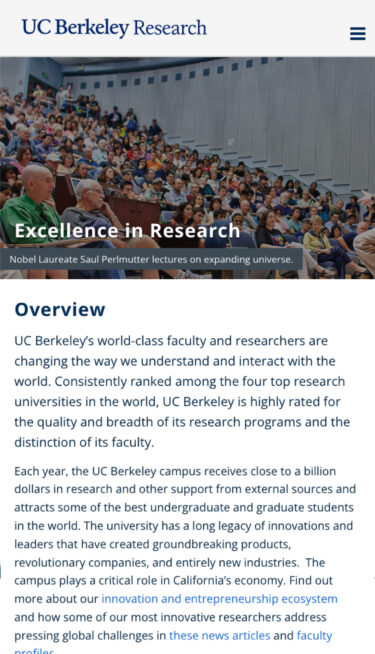
VC Berkeley Mobile Gallery
The challenge
Berkeley’s VCRO team came to Kanopi carrying three interconnected challenges.
First, the site was running an aging version of Drupal, with deprecated modules and a CKEditor 4 to 5 migration still outstanding. A platform upgrade wasn’t optional, as it was the foundation upon which everything else depended.
On top of that, faculty teaching data was managed through a fragile three-tier middleware pipeline that required a developer to manually SSH into a server twice a year to refresh course data. When it broke — and it regularly did — only a developer could fix it.
Meanwhile, the Expertise Finder — a search tool for users to find UC Berkeley experts — was built on keyword matching that couldn’t keep up with the breadth and nuance of academic research across hundreds of disciplines.
The Berkeley team needed a partner who could address all three at once.
The solution
We treated this as one engagement that progressed in three phases.
Upgrading to a stronger foundation
We started where we had to: the platform. Not as a prerequisite to check off, but as the foundation that made everything else possible.
We executed a phased upgrade from Drupal 10.6.5 to 11.3.5, stabilizing the D10 environment first, then upgrading core with Symfony 7.4. Other technical upgrades included all database update hooks being applied cleanly, patching a known Views bug, and QAing the full site before a coordinated production deployment.
Course API integration
With the platform stable and future-ready, we replaced a fragile, decade-old course data pipeline with a modern, native Drupal integration that gives the content team full visibility and control. The previous system relied on a separate middleware server and manual, twice-yearly script runs to keep faculty teaching information up to date, with no error handling and no way for the VCRO team to intervene when something broke.
Kanopi built a direct integration with UC Berkeley’s Class API, bringing course data natively into the Drupal site with automated syncing, real-time search indexing, and an admin interface that lets editors trigger updates and monitor sync status without developer involvement. This provides full editorial control over course visibility, and eliminates a legacy system that had been a long-standing point of risk for the site.
Expanded AI site search
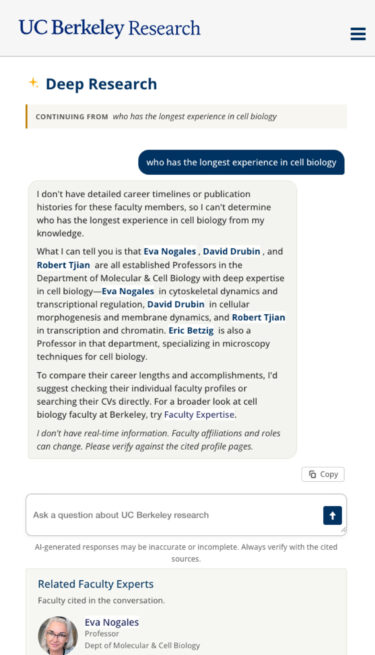
Lastly, to help connect researchers with the right expertise faster, Kanopi built an AI-powered Expertise Finder capable of handling natural language queries. The feature combines a vector database (Zilliz) with Claude AI models and the OpenAlex research database to let visitors search using natural, conversational language, such as “who has experience with international economics”, rather than relying on exact keyword matches alone.
Development was refined through close collaboration with the VCRO team across multiple rounds of relevance tuning, covering search ranking, autocomplete behavior, and matching faculty publication records to their profiles via ORCID and OpenAlex enrichment. At launch, the enrichment process successfully matched over 1,500 faculty profiles to their research output, with that number continuing to grow as additional researcher identifiers are added.
But we didn’t stop there. Building on the Expertise Finder’s foundation, Kanopi launched an expanded AI Site Search experience called “Deep Research” assistant that makes it dramatically easier for visitors to find what they’re looking for.
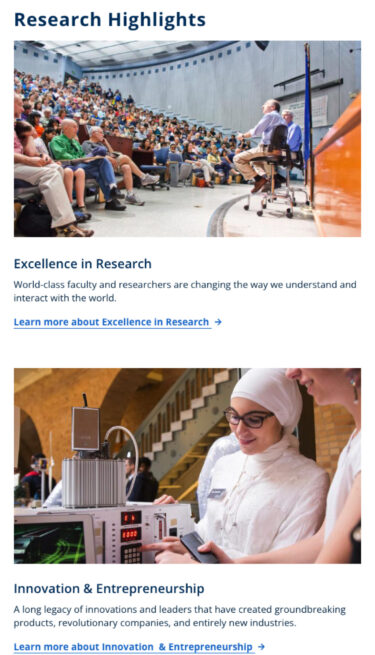
Clicking the Deep Research CTA on the right side reveals even smarter search results. Results are ranked so the most relevant content, whether a faculty page, news article, or program page, surfaces first; recent news is prioritized appropriately; and common abbreviations and shorthand are understood automatically, so a search for “I&E” returns results for Innovation & Entrepreneurship without visitors needing to know the exact terminology.
Aside from the AI powered tools, spellcheck and query handling have also been refined to reduce dead-end searches. Traditional keyword search saw meaningful improvements as well, with refined facets and filters, including clearer labeling to distinguish faculty-specific search criteria from general site content, so visitors can narrow results by content type, department, or research area with more precision.
Key features
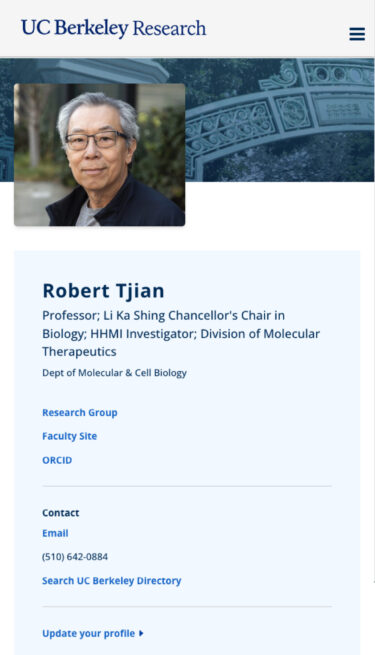
Course API integration of Faculty Profiles
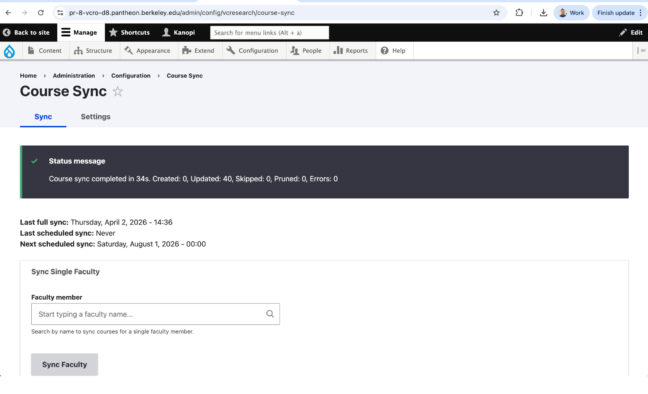
A custom Drupal module now pulls course data directly from the Berkeley SIS Class Sections API on an automated schedule, stores it as structured content nodes, and renders the teaching tab server-side. Editors can trigger a sync, see when it last ran, and review any errors — no developer required.
Expertise Finder with AI
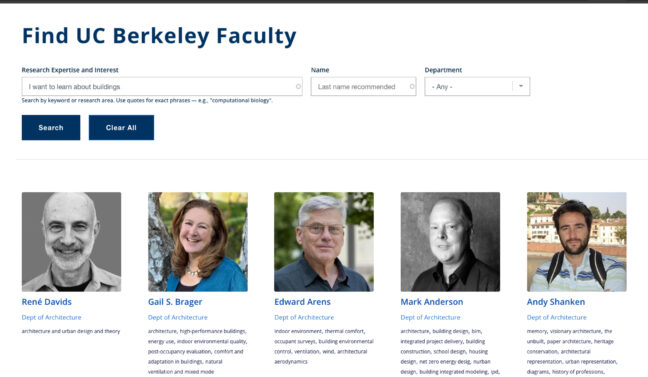
To help connect researchers with the right expertise faster, Kanopi built an AI-powered Expertise Finder. The feature combines a vector database (Zilliz) with Claude AI models and the OpenAlex research database to let visitors search using natural, conversational language, such as “who has experience with international economics”, rather than relying on exact keyword matches alone.
Deep Research mode
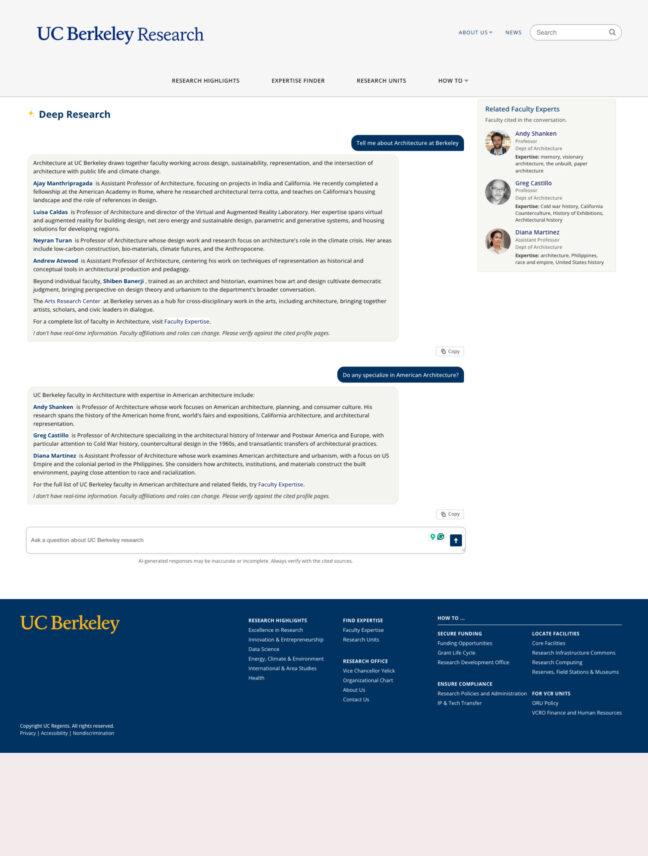
Building on the Expertise Finder’s foundation, Kanopi launched an expanded AI site search experience that goes deeper and more conversational (think Claude or ChatGPT). Users can ask natural questions and get back relevant experts, research, and content through the new “Deep Research” mode, making it dramatically easier for visitors to find what they’re looking for.
The result
vcresearch.berkeley.edu now runs on the strength of Drupal 11, with a fully automated course data pipeline and a clear roadmap for what comes next.
As for the Teaching Tab, the content team now manages course syncs independently. The teaching tab on every faculty profile loads server-side, with no external HTTP calls and no silent failures. Course content is visible to search engines for the first time. And the middleware site that previously required ongoing maintenance is being decommissioned entirely.
But the most exciting feature for visitors is the AI-powered semantic search experience. Developed through close, iterative collaboration with the VCRO team, Berkeley’s search is now capable of handling natural language queries and relevance. The result is a modern, AI-driven search experience that feels less like querying a database and more like asking a knowledgeable colleague, helping visitors discover the right people and information faster and with far less friction.